
Ancient Egypts Bastet: From Lioness Goddess to Divine Protector

Introduction
The ancient Egyptian pantheon is rich with figures who embody the diverse forces of nature, survival, and the domestic sphere. Among these powerful deities, Bastet stands out not only for her striking iconography but also for her remarkable evolution. She is the archetype of the shifting divine, a figure whose very image adapted to reflect changing cultural and religious priorities within Egyptian society. Bastet’s enduring influence stretches from the majestic, protective energy of a lioness to the approachable, affectionate grace of a household feline. For those seeking to understand the deep well of Egyptian folklore, understanding Bastet requires looking beyond her physical form to grasp the complex ways she served as a multifaceted protector in the lives of the Egyptian people.
From Ferocity to Grace: The Evolution of a Goddess
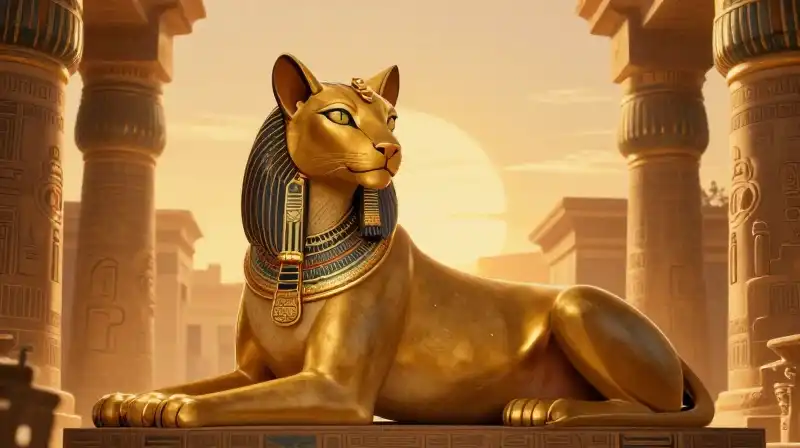
The transformation of Bastet’s identity is central to her cultural history, revealing much about the evolving needs of the ancient people. Initially, Bastet’s origins are strongly linked to the powerful, wild nature of the lioness, a symbol of untamed might and fierce defense. Early attestations, particularly those from the 2nd Dynasty near Memphis, portray her as an anthropomorphic woman crowned by the formidable head of a lioness, suggesting a deity rooted in raw, protective strength 1. However, as the millennia passed, her depiction began to shift toward the more domestic and familiar cat. This transition was not merely aesthetic; it signified a theological realignment. The adoption of the gentler, domesticated cat symbolized a benevolent power—a divine protection that was kinder and more accessible. This move allowed Bastet to align with the pervasive domestic reverence for feline protection 1. As she moved from representing a fierce warrior goddess to a more gentle, accessible feline deity, her role widened, encompassing the realm of health, pleasure, and the comfort of the home (1, 2).
The Divine Protector: Life, Health, and the Domestic Realm
Bastet functioned as a pervasive and deeply personal deity within Egyptian life. She was not simply a goddess of the cat; she was a comprehensive guardian. Her divine purview covered several critical aspects of existence: protection against evil and illness, good health, and the nurturing aspects of life (1, 2). Furthermore, she held significant associations with fertility and childbirth, acting as a benevolent force during moments of life’s most vulnerable transitions 1. This pervasive influence means that for a community living by tradition, Bastet was a spiritual anchor in the domestic sphere. Her cultural significance extended beyond monumental temple rituals; she lived in the homes, symbolized in protective amulets and offerings. Her complex identity also included a notable overlap with other powerful female figures, such as Sekhmet, the fierce protector, or the Eye of Ra, illustrating the holistic nature of divine protection in the ancient Egyptian worldview (1, 3).
Bubastis: The Heart of Feline Cult Practice
While her influence was widespread, the city of Bubastis in the fertile Nile Delta served as her most significant cult center. The name itself—a translation meaning “House of Bastet” 1—speaks to the profound devotion centered there. The practices at Bubastis offered a vivid window into the community’s spiritual life. Cult traditions involved massive annual festivals that brought together large crowds. These events were immersive communal experiences, featuring dancing and singing while participants sailed down the Nile 1. A defining characteristic of the temples dedicated to Bastet was their unique interaction with the environment, particularly water. Many of these temples were situated amidst lakes known as *isheru*, and their design incorporated these water elements into the religious experience 1. This water motif highlights the importance of renewal and purity in their rituals. Furthermore, iconography frequently depicted Bastet holding a ceremonial sistrum—a traditional instrument of divine ritual—often rendered in fine materials such as alabaster (1, 2).
Beyond Egypt: The Cultural Reach of Bastet
The influence of the Bastet tradition was not confined to the borders of ancient Egypt. As her cultural footprint expanded, her cult traveled with the trade and interactions of the ancient world. As early as the 1st millennium BCE, her worship was established in the Mediterranean region. Her temples appeared in distant places like Sakkara and Alexandria 1. This wide cultural reach suggests that the concept of a benevolent, highly protective feline deity resonated with and was adopted by other surrounding communities. Mythological narratives further elaborate on her role as a heroic figure. One notable tale recounts her participation in celestial and defensive events, such as the rescue of the Eye of Horus from the villain Seth at the Bubastis temple (2, 3). This narrative reinforces her identity as a champion of order and rightful protection.
Understanding Symbolism and the Tradition’s Meaning
For those interested in the deeper meaning of Bastet and her symbols, the tradition is rich with layers of meaning. The various depictions—whether in full lioness form or with a stylized cat head—each carry symbolic weight relating to power, grace, and divine oversight. Related searches often inquire about Bastet’s meaning, and understanding her life involves connecting her to the concept of *Ish-Heru* (divine protective oversight). In terms of iconography and offerings, Bastet was associated with specific elements of luxury and ritual, reflecting her status. Her association with royal ideology and the use of protective ointments is suggested by hieroglyphic references to the jar symbol (1, 3). In the context of offering traditions, these often included items that symbolized purity and domestic well-being, such as grains, wine (consumed in large quantities during festivals at Bubastis), and aromatic materials 1.
Synthesis: The Enduring Value of Bastet’s Legacy
The story of Bastet is far more than a collection of ancient myths; it is a living record of how humanity interprets and structures protection. The evolution from the fierce lioness to the domesticated cat illustrates a cultural intelligence—the ability of a community to adapt its spiritual needs and imagery to match their societal progress. Whether a devotee was seeking protection in the wild or comfort within the walls of a home, Bastet offered a powerful, adaptable form of feminine strength. Her legacy endures as a testament to the human desire for harmony, balance, and the divine protection that sits at the intersection of raw power and gentle care.
References
Footnotes
Related Articles