

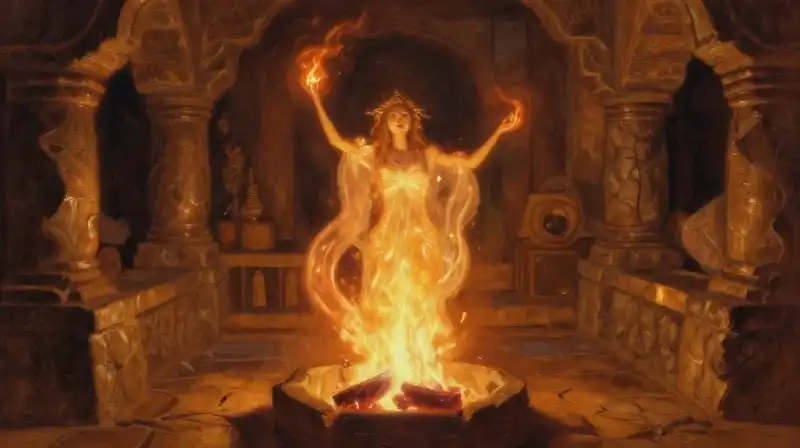
Hestia: The Ancient Goddess of Hearth and Home

Introduction
At the heart of any community, whether it is a sprawling ancient polis or a single modern household, lies the hearth—the enduring center of warmth, sustenance, and gathering. This sacred space has been personified across human history, and perhaps no figure encapsulates this powerful domestic devotion as completely as Hestia. She is not merely a deity of the fire, but the embodiment of the *oikos*, the holistic concept of domestic life, family, and the sustained vitality of home itself 1. To understand Hestia is to understand the deep-seated cultural reverence for rooted belonging, the quiet strength of continuous life, and the belief that the private sphere holds profound, sacred significance.
The Ancient Sacred Fire: Hestia and the Domestic Sphere
In classical Greek religion, Hestia’s role transcended the physical act of warmth. She served as the foundational anchor of civic and domestic ritual. While her presence in major myths is sometimes portrayed as limited due to the fixed nature of the hearth, her function was undeniably critical. She was traditionally recognized as the recipient of the initial offering during domestic sacrifices, setting the spiritual tone for all rituals within the home 1. Her ultimate sanctuary, the public hearth located at the prytaneum, cemented her status as a crucial point of communal gathering and foundational ritual in Greek society 1.
This reverence for the domestic fire had profound resonance in neighboring cultures. The Roman people shared this devotion, elevating Vesta to a similarly vital position. Vesta functioned as the divine personification of Rome’s domestic fires and public stability, mirroring Hestia’s role as the guarantor of the household 1. These figures demonstrate a universal human recognition: the stable, persistent flame is not just a source of heat, but a symbol of enduring culture and life.
Global Equivalents: Hearth Deities Across Tradition
The spiritual concept of a benevolent hearth deity is remarkably consistent globally, appearing in vastly different cultural contexts. These figures often represent the core tenets of survival and continuity within a given landscape.
- Zoroastrian Atar: In the ancient Persian tradition, the holy fire *atar* is central, representing purity and divine presence, linking the celestial to the terrestrial 1.
- Scythian Tabiti: This deity is associated with hearth and domestic life among the Scythians, showing the widespread nature of this spiritual focus 1.
- Protectors of the Threshold: Beyond the fire itself, the concept of domestic guardianship is often linked to ancestral spirits. In Roman belief, the Lares and Penates served as protectors of the home, reinforcing the sanctity of the domestic space—a theme closely aligned with Hestia’s influence 1.
The Living Tradition: Hestia in Modern Practice
For contemporary spiritual practitioners, particularly those within modern pagan and neopagan communities, Hestia’s role has evolved into a profoundly personalized and intentional practice. Rather than being viewed solely as a distant, immobile figure from classical lore, modern interpretations emphasize her dynamic role in nurturing the self and maintaining the domestic ecosystem 1.
This modern practice is characterized by dedication and hospitality. Practitioners often treat their entire kitchen—the heart of daily life—as a personal shrine. Ritual acts might include dedicating the flame of daily cooking to Hestia, recognizing the energy required to sustain life, comfort, and nourishment 1. This contemporary Hestia represents not just the fire that keeps the house warm, but the inner dedication required to maintain a harmonious and self-nourishing life 1.
The Nuance of Domestic Divinity: Context and Meaning
A central complexity when studying hearth deities is reconciling their ancient roles with modern perceptions. Hestia is frequently observed in classical texts as an immobile, somewhat reserved figure. This fixed nature—the steadfastness of the hearth—is her primary attribute. However, this immobility does not mean inactivity; rather, it signifies permanence and reliable support for the community and family.
When we look at figures associated with domestic sanctity, we see a recurring pattern of protection and life-giving energy. For instance, the British Brownie, like the Celtic goddess Brigid (who also represents home and hearth), serves as a local, protective entity ensuring the well-being of the home. These figures show how the sacred and the everyday intertwine, providing a spiritual layer to the mundane tasks of life 1.
Addressing Common Interpretations:
- Who is the Celtic goddess of home and hearth? The goddess Brigid is a prime example of a Celtic deity associated with home, fire, and craft.
- What was Hestia’s role? She embodies the principles of hospitality, devotion, and reciprocity, promoting a state of continuous self-nourishment within the family unit 1.
The Cultural Weight of the Hearth
Hestia’s enduring relevance lies in her ability to unify the sacred and the practical. She reminds communities that the deepest rituals are often the most commonplace: preparing a meal, gathering around a flame, or sharing a home with loved ones. She is a powerful archetype for self-sufficiency and devotion. As the divine symbol of the domestic hearth, Hestia transcends regional myth and acts as a timeless reminder of the necessity of internal stability, quiet strength, and the enduring warmth found within the shared home.
References
Footnotes
Frequently Asked Questions
Who is the Celtic goddess of home and hearth?
The goddess Brigid is described as a prime example of a Celtic deity associated with home, fire, and craft.
What was Hestia's vow of virginity?
The provided article does not mention Hestias vow of virginity or describe any specific personal vows she took.
Which goddess is associated with the hearth and home?
In Greek religion, Hestia is the figure who embodies domestic life, family, and the sustained vitality of the home. Other goddesses mentioned, such as Vesta of Rome and Scythian Tabiti, are also associated with domestic life and hearth fires.
Related Articles