Freya: The Complex Norse Goddess of Love, War, and Magic

Introduction
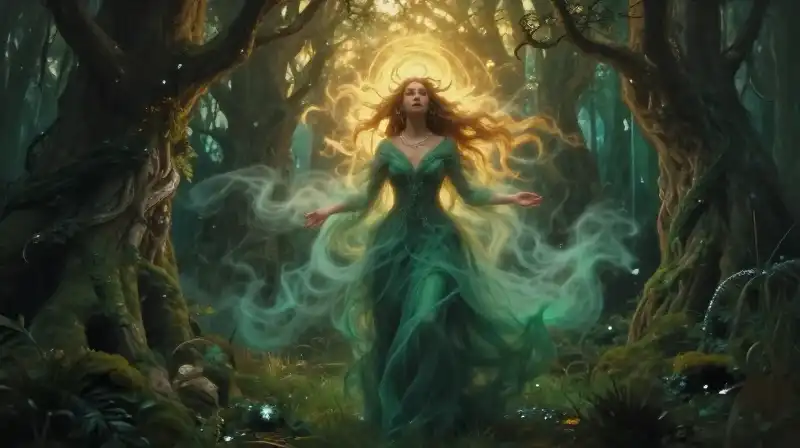
The figure of Freya within the Norse tradition is far from a simple definition of ‘goddess of love.’ To understand her is to grasp a cultural complexity that integrates profound themes: the duality of existence, the power of nature’s cycles, and the raw strength required to navigate both joy and immense grief. Known in Old Norse as meaning ‘lady’ or ‘mistress,’ Freya embodies a potent and often contradictory force—she rules not just over the heart, but also over the battlefield, the wealth of the earth, and the mystery of the afterlife (1, 2). For those seeking to understand ancient heritage, the core of Freya’s meaning lies in this powerful combination, illustrating a worldview where human experience, whether through creation or conflict, is intimately connected to the divine.
The Dual Kingdom: Fertility and Conflict
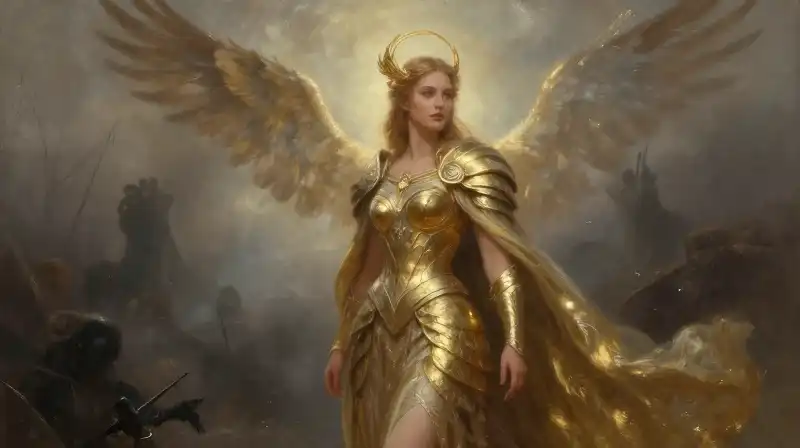
One of the most defining aspects of Freya’s divine role is her ability to seamlessly traverse two seemingly opposite domains: that of nurturing abundance and that of mortal strife. She is inextricably linked to fertility and agricultural cycles, and rites involving her were historically invoked to bless marriages, ensure good harvests, and promote the birth of strong children 1. Her connection to the tangible blessings of the land, and indeed human life, is clear. Yet, this nurturing side is balanced by a ferocious capacity for power and destruction. Freya governs not only her celestial hall, Fólkvangr, but also plays a significant part in the warrior’s passage. In the Norse belief system, Fólkvangr is where she receives exactly half of all the warriors who are slain in battle. This contrasts with Odin’s Valhalla, which receives the other half (1, 2). This unique division suggests a complex relationship with warfare; she is not merely a distant observer, but a primary recipient of the ultimate price of valor, linking martial glory directly to her domain of power. Furthermore, her association with wealth is materialized through powerful symbols, most notably her magnificent golden necklace, Brísingamen, which serves as a physical link between the pursuit of precious materials and her domain of life and fertility (1, 2).
Master of Seiðr: Magic, Transformation, and Intellect
Beyond her physical attributes and domain over battles, Freya is profoundly associated with the mystical art of *seiðr*. This is not merely a passive power; it is a potent form of magic used for prophecy and influencing the unseen future (1, 2, 3). The scholarly understanding of Freya’s role in *seiðr* is so significant that some sources have suggested she may have even been the originator of this powerful knowledge, potentially teaching it to Odin (1, 2, 3). This ability to see and influence fate elevates Freya from a simple goddess to a master of cosmic knowledge. This mastery is mirrored in her attributes of movement and transformation. The presence of her cats and the lore of her ability to shift into a falcon using a feathered cloak suggest a profound intertwining of animal symbolism with her powers (1, 2). These elements speak to a tradition where the boundaries between the physical and the spiritual, or between human and animal power, were fluid. In a cultural context, this transformation reflects the ever-changing nature of fate and the unpredictable paths of life itself.
The Weight of Grief and Connection
A critical, and often overlooked, dimension of Freya’s persona is her deeply human capacity for sorrow. Her narratives are frequently defined by a potent grief, most notably captured in her role as a weeping mother following the death of her son, Balder 1. This portrayal elevates her beyond the archetype of the invincible warrior, presenting her as a figure of profound emotional complexity. The descriptions of her weeping tears of red gold underscore this fusion of personal tragedy and divine power (1, 2, 3). Regarding her personal relationships, the persistent absence of her husband, Óðr, in the mythological narratives, further emphasizes her multifaceted, often mournful presence (1, 2, 3). This focus on profound loss, coupled with her association with intense desire among the giants (resulting in mythological attempts to capture her, 1, 3), defines her not just by her power, but by her intense, complex human-like emotions.
Regional Echoes and Enduring Legacy
While the grand narratives of Freya’s myth are preserved in central Norse traditions, her presence lives on in smaller, regional cultural elements. In the Icelandic literature and folklore, her strong associations with fertility and love demonstrate how these traits were specifically understood within certain regional traditions 1. Furthermore, before the Christianization of the Scandinavian regions, her influence was so pervasive that her name is found even in local folklore, such as the naming of specific plants in southern Sweden 1. The sheer complexity of her myths—where details about her powers and relatives vary significantly across different scholarly or source materials 1—highlights how a central figure can adapt and evolve within a living tradition. In modern cultural discussions, such as those surrounding the meaning of “Freya or freyja goddess,” readers are navigating this layered history, recognizing her not just as a mythological concept, but as a synthesis of creation, chaos, and cyclical life.
Synthesis of Meaning
Freya is not a static deity; she is a mirror held up to the community’s own understanding of the balance in life. She holds the gold of fertility in her hand while receiving the steel of the fallen warriors. She embodies the potent truth that the things we cherish most—our love, our bounty, our sons—are inextricably linked to the risks we take and the grief we bear. For those engaging with these ancient stories, Freya offers a rich cultural framework for understanding that the most powerful forces in any life are those that embrace both the blossoming of spring and the cold certainty of winter.
References
Footnotes
Frequently Asked Questions
Who is Freya's true love?
The article mentions the persistent absence of her husband, Óðr, in the mythological narratives. It describes her as a figure of intense desire and complex human-like emotions, but does not name a specific true love for her.
Related Articles