
Osiris Various Heads: From Atef Crown to Ram Form

Introduction
The varied forms and regalia of the god Osiris are far more than mere decoration; they function as a visual shorthand for the complex Egyptian relationship with death, rebirth, and the fundamental cycle of fertility. To study the different “heads” of Osiris—whether the royal Atef crown, the earthly ram of Banebdjedet, or the composite visage of Seker-Osiris—is to study the theological and cultural pillars of Egyptian identity itself. Osiris, the deity of the afterlife and the renewal of vegetation, was a central figure whose iconography helped shape a culture that viewed life and death not as opposites, but as intertwined aspects of a single continuous cycle 1. His representation was dynamic, evolving from local origins, particularly in Busiris, to become a god of universal cult throughout Egypt 1. Understanding these different heads is essential to grasping how the Egyptians perceived sovereignty, cosmic order, and the promise of eternal life.
The Sovereign Face: Osiris and the Atef Crown
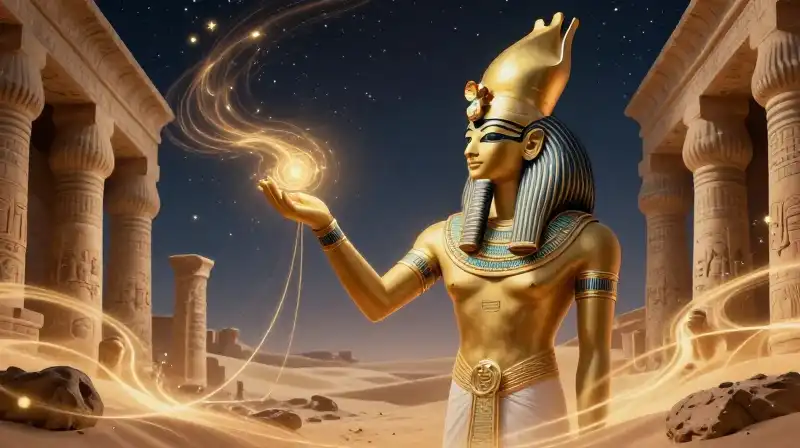
The most iconic and enduring representation of Osiris is defined by the majestic Atef crown. This elaborate headgear, which combines the White crown of Upper Egypt with two curling ostrich feathers, immediately establishes Osiris’ divine status and supreme authority (1, 2). The Atef crown is not simply a royal cap; it signifies the god’s comprehensive dominion over both the terrestrial and celestial realms. In this primary form, Osiris is frequently depicted wearing the pharaoh’s beard and possessing a mummiform appearance, symbolizing his connection to the underworld and his role in the resurrection process. His skin tone was also highly symbolic. He could be shown with green skin, signifying constant rebirth and the vitality of spring, or with black skin, a powerful allusion to the rich, fertile soil and the life-giving floodwaters of the Nile (1, 2). These specific attributes helped ground the abstract concept of divine death into a concrete, agricultural reality.
Continuity and Stability: The Ram Forms
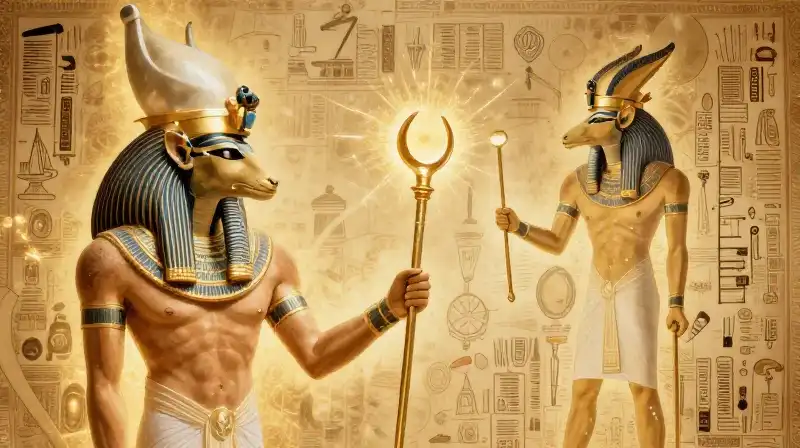
Beyond the regal Atef-crowned figure, the tradition of Osiris encompasses forms tied directly to stability, continuity, and cosmic law. One of the most compelling of these is the aspect known as Banebdjedet. This form represents a specific aspect of Osiris’ soul, which was often manifested as a living, sacred ram 1. The use of the ram head symbolizes a stable, enduring force—a living constant amidst the chaos of creation and dissolution. By manifesting as this animal form, Osiris represented a necessary point of continuity within the perpetual cycle of death and renewal 1. This suggests that even in his most transformative moments, his core essence was rooted in an unyielding, consistent order. These varied forms allow the deity to speak to different facets of existence: the Atef form speaking to kingship and authority, and the ram form speaking to underlying, persistent cosmic stability.
Syncretism: When Heads Merge and Traditions Shift
The Egyptian pantheon was not static; deities frequently merged or shared attributes, a process known as syncretism, which enriched the mythological landscape. Osiris was often linked to other powerful gods, resulting in unique composite forms. A notable example is the god Seker-Osiris. This figure is a blend of Osiris’ authority and the attributes of Seker, who was depicted with a hawk head. The resulting composite head illustrates how different functions of divine power could be unified. The resulting iconography would combine the essential features of Osiris—the Atef-crown, the crook, and the flail (which together reinforce his role as a sovereign authority over life and death)—with the symbols of Seker 1. This shift demonstrates that the concept of the “Osiris head” was highly flexible, adaptable to fit the specific theological needs or regional preferences of a particular community. Some historical artistic depictions further complicated this, showing Osiris possessing a composite head featuring a ram, emphasizing these complex regional variations 1.
The Cultural Weight: From Myth to Practice
To understand why these varied heads and forms mattered to the people, one must look at how the divinity was internalized by the community. The adoption of Osiris as a central pillar of Egyptian identity was profound. His myth—being murdered by his brother Set and subsequently resurrected by his wife, Isis—is a powerful narrative of renewal that permeated all levels of society (1, 2). The relationship between Osiris and the living Pharaoh was profoundly symbolic. The living king was seen as linked to the sky god Horus, but his eventual identity was believed to fuse with Osiris upon his death. This connection operated through a mechanism of “imitative magic,” where the pharaoh could inherit eternal life by uniting with the rising, reborn power of Osiris 1. This belief lived in practice through public festivals, such as the annual celebrations at Abydos. These events were not merely ceremonies; they were public reenactments of the god’s journey from death and his eventual resurrection, allowing the community to participate directly in the promise of renewal 1. Even the intimate rituals, such as the creation of the “Osiris garden”—a mold filled with Nile water and seeds meant to sprout grain—was a practical, symbolic reenactment of Osiris’ vital strength and resurrection 1.
Understanding the Iconography of Sovereignty
The tools associated with Osiris are just as telling as his headgear. The crook, often viewed as a shepherd god’s implement, and the flail are potent symbols that define his role. Collectively, they reinforce his position as a sovereign ruler—not merely a divine being, but the authoritative governing power over the cycle of life and death 1. While the etymology of the name Osiris remains a subject of scholarly debate, his visual language, from the dual significance of his skin colors to the powerful blend of the Atef crown and the Ram-like forms, creates a consistent, powerful message: renewal is inevitable. By embracing these diverse forms, the Egyptian tradition provided its people with a powerful, resilient framework for navigating the cyclical nature of existence.
References
Footnotes
Frequently Asked Questions
What was Osiris' head?
Osiris head varied across several forms, including the iconic Atef crown, which combines the White crown of Upper Egypt with two curling ostrich feathers; the ram form known as Banebdjedet; or the composite visage of Seker-Osiris, which incorporated attributes like a hawk head.
Related Articles