
Who Was Shai? The Egyptian God of Fate and Destiny

Introduction
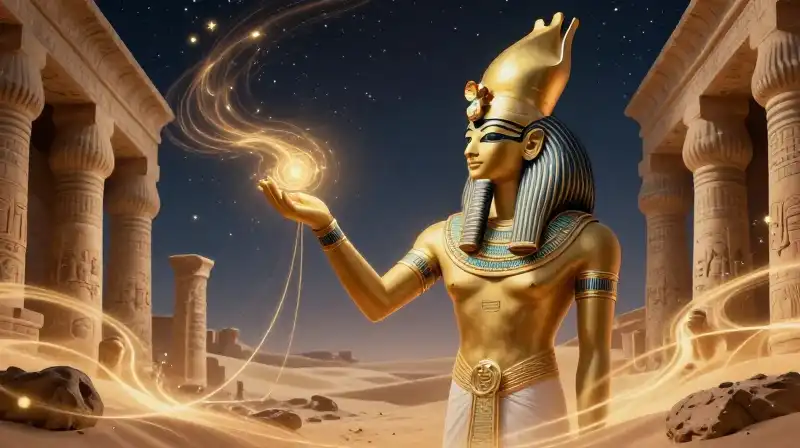
To understand the concept of Shai is to glimpse the deeply philosophical structure of ancient Egyptian cosmology, where existence itself was not accidental but profoundly predetermined. Shai (transliterated as Sai or Shay) represents the foundational concept of fate or destiny, derived from the ancient Egyptian understanding of “that which is ordained” (1, 2). For the ancient Egyptian community, Shai was not merely a deity of chance or mere fortune; he embodied the literal decree of life and death, the ultimate authority over the measure of a person’s existence. This tradition speaks to a worldview where every human life, from the moment of birth until the final reckoning in the underworld, was meticulously recorded and overseen by the divine power of destiny (1, 2).
The Divine Ledger: Shai and the Measure of Life
The most profound cultural role ascribed to Shai was his function as the arbiter of a life’s length. It was believed that this deity determined the precise duration of every individual’s life, connecting the very beginning of human existence to its inevitable end (1, 2). Unlike deities who might influence a life’s path or bestow boons, Shai was the inherent measure of life itself. Once an individual was born, Shai was considered to be a permanent presence by their side, keeping an account of their deeds and existence (1, 2). This presence remained constant until the moment of final judgment. In the realm of the Duat (the Egyptian underworld), Shai played a crucial role in the Hall of Judgment, presenting the factual account of an individual’s life to the gods (1, 2).
Ambivalence and the Authority of Fate
The power of Shai was not benevolent in a simple sense; it was inherently ambivalent. He held the divine authority to either protect or damn an individual, as his function was to present an objective, factual account of a soul’s life 1. This emphasizes that Shai’s role was not one of moral judgment in the way that might be later conceived, but rather one of absolute record. However, the implications of that record were absolute: a flawless record could ensure passage, while one stained by wrong could lead to damnation 1. This powerful concept of destiny permeated all levels of Egyptian society, illustrating the cultural belief that even the most powerful figures—including the pharaoh and the great gods themselves—were subject to the ultimate jurisdiction of fate 1.
Evolution Across Egyptian Eras
The concept of Shai was not static; it shifted and evolved significantly throughout the history of Egyptian civilization. During later periods, the theological lines between various deities blurred, leading Shai to be conceptually identified with other powerful figures. He was often linked as the husband to Meskhenet, the goddess of childbirth, or Renenutet, the goddess of fortune and destiny (1, 2).
The most dramatic shift occurred during the monotheistic era of Akhenaten. Under this intense religious reorientation, the traditional concept of fate was reframed: the Aten (the sun disc) was asserted to be the ultimate Shai, the source that granted all life 1. Later, this divine authority was explicitly claimed by Pharaoh Ramesses II, who publicly asserted the title “Lord of Shai,” solidifying his own authority over the decrees of destiny (1, 2). These shifts demonstrate the adaptability of Egyptian religion, where core concepts like fate could be aligned with prevailing political and theological powers 1.
Echoes in Classical Traditions: Shai and Agathodaemon
The influence of Shai extended far beyond the borders of the Nile. When Egyptian cultural ideas were encountered by the Hellenic world, Shai’s role was assimilated into the tradition of Greek fortune-telling. His identity blended with the Greek god Agathodaemon, who was revered as the god of soothsaying and fortune telling (1, 2). This syncretism led to unique artistic representations that bridged the two traditions. A particularly striking variation occurred when Shai was identified with the serpentine god Agathodaemon, resulting in an unusual depiction: a serpent-headed pig (1, 2). This fusion, though culturally fascinating, reveals the diverse ways foreign traditions are absorbed and reinterpreted by neighboring societies, demonstrating a shared root in the understanding of destiny 1.
The Forms of Destiny: Iconography and Counterparts
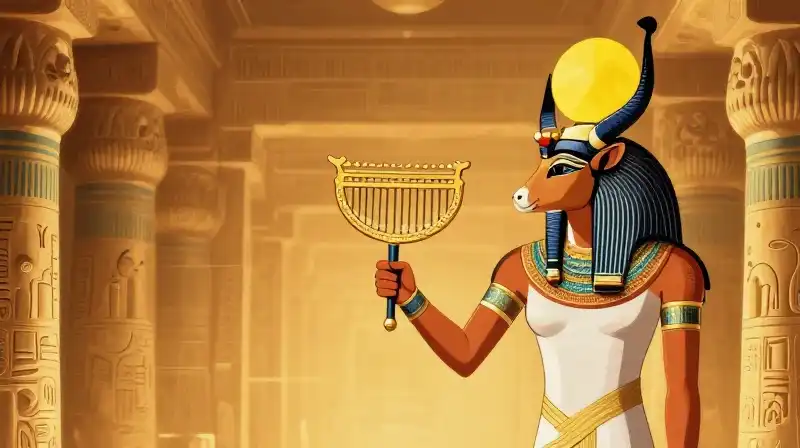
While often generalized as a male deity, the record reveals a more nuanced presence. Shai had a female counterpart known as “shait,” indicating a duality within the tradition (1, 2). Furthermore, the visual representation of the god was not singular. While generalized depictions featured a male form, less common but significant depictions included a man with the head of a snake, or even small birth bricks featuring a simple human head, suggesting a wide variety of ways the concept of destiny was made tangible 1. It is important to note, however, that despite the specialized belief in Shai, available historical evidence suggests that very few dedicated cult activities or temples were built specifically for his worship, meaning his significance was often more conceptual than institutionally grand 1.
The Persistence of Fate: Meaning and Legacy
The tradition surrounding Shai provides a profound insight into the Egyptian psyche: the acceptance of predetermined boundaries coupled with a focus on the quality of one’s actions within those boundaries. Shai was the immutable structure, but the account he presented was a reflection of the individual’s life 1. While specific devotions to Shai have left few monumental traces, the concept survived and migrated, blending with the Greek gods and influencing notions of fortune across the ancient world. Understanding Shai helps the modern reader grasp how ancient cultures framed the relationship between individual free will and cosmic order, illustrating that even in a world governed by destiny, the quality of one’s life remained paramount (1, 2).
References
Footnotes
Related Articles