Anubis Explained: The Jackal-Headed God of the Egyptian Underworld

Introduction
Anubis stands as one of the most recognizable and profoundly symbolic figures in the ancient tapestry of Egyptian spirituality. He is not merely a deity associated with the dead; he is the active orchestrator of the most crucial passage in the Egyptian worldview: the transition from life to eternal existence. This god is the critical overseer of funerary rites, acting as a solemn guide through the Duat (the underworld) and a steadfast protector of the necropolis (1, 2). When readers contemplate the image of the jackal-headed god of Egypt, they are encountering a complex blend of reverence, natural observation, and deep religious function, representing the ultimate safeguarding of the deceased and the promise of rebirth.
The Symbolism of the Black Jackal
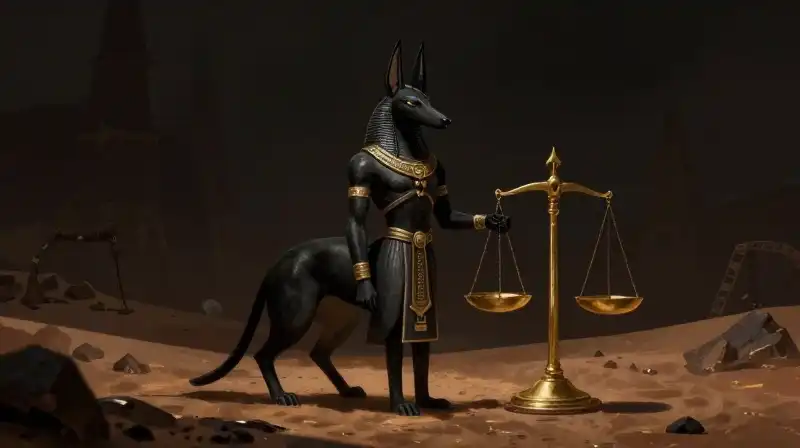
The defining feature of Anubis—the jackal’s head, whether canine or a true jackal—is not merely a visual motif but a powerful cultural code. The jackal, particularly the black jackal, served as a physical and spiritual bridge between the mundane world and the realm of the dead. According to scholarly accounts, the color black itself carried immense symbolic weight in Egypt, representing rebirth, fertility, and the fertile, rich soil of the Nile (1, 2). Crucially, the association with the jackal held a practical, almost pragmatic element. Ancient Egyptian culture mirrored the scavenger nature of these animals, believing that the jackals naturally protected bodies in the cemeteries from being consumed by other predators (1, 2). This belief transformed a natural observation into a powerful divine mandate, positioning Anubis as a divine sentinel who would safeguard the physical remains of the honored dead. The portrayal often depicts him with this iconic black head, symbolizing not only protection but also the potential for renewal inherent in the cycle of the Nile and the afterlife (1, 2).
Guardian of the Transition: Anubis in the Afterlife
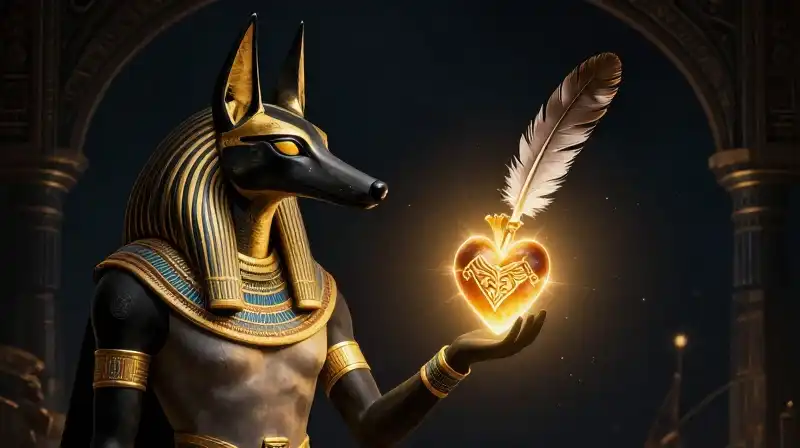
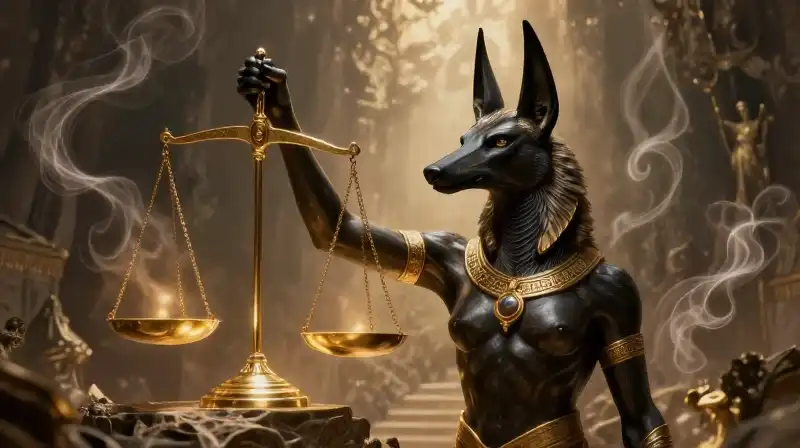
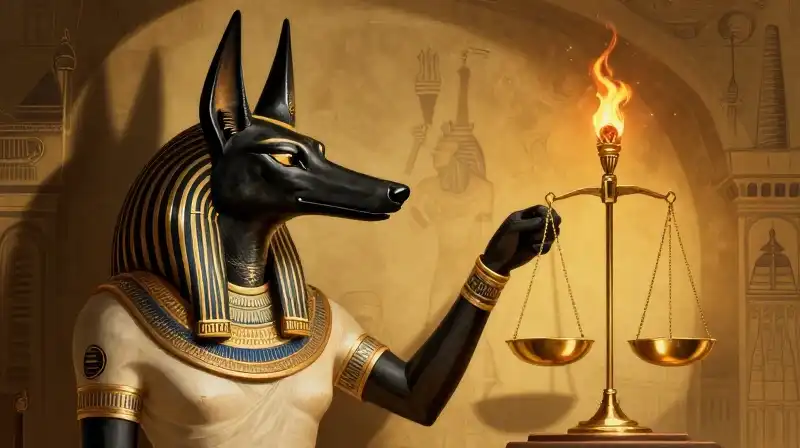
The role of Anubis was fundamentally tied to the moments of profound change—the transition between the two worlds. As the deity of embalming, his presence was integral to the highly ritualized processes of mummification. He was recognized as the patron god of those skilled in these sacred rites (1, 2). His involvement wasn’t just in the preparation of the body but in guiding the soul through its most pivotal moment. This culminates in his central position during the Judgment ceremony, often referenced in the Hall of Two Truths. Anubis oversaw the critical weighing of the heart against the feather of Ma’at, the goddess of truth. By managing this process, he ensured that the deceased met the necessary criteria for eternal life 1. Historically, this role was so critical in the Old Kingdom that his influence dominated the understanding of the afterlife, yet the focus of the underworld eventually shifted. Over time, during the Middle Kingdom, the primary role of the lord of the underworld transitioned to Osiris, though Anubis remained an enduring and vital aspect of funerary practice 1.
The Evolution of a Deity: Adaptation and Syncretism
The history of Anubis is not static; it is a story of adaptation, theological refinement, and cultural fusion. Scholarly research into his origins reveals various mythological traditions. Early accounts suggest him as the son of Ra, but a more common later depiction portrays him as the offspring of Osiris and Isis 1. His titles reflected the scope of his authority, including “Foremost of the Westerners” and “The Dog who Swallows Millions,” titles that emphasized his role as a powerful guardian and keeper of secret knowledge 1. Regional variations also offer a deeper glimpse into the diversity of ancient Egyptian belief. For instance, a specific tradition within Nubia detailed a unique cultural perspective wherein Anubis was viewed as the husband of his mother, Nephthys 1. As Egyptian civilization interacted with external powers, Anubis demonstrated profound flexibility. During the Ptolemaic era, this flexibility led to a powerful cultural syncretism. He merged with the Greek god Hermes, forming the deity Hermanubis. This fusion reflected the shared, cross-cultural belief in the essential journey of the soul 1.
Understanding the Tradition’s Context
To understand the cultural footprint of this deity, one must look beyond the iconography of a jackal and see the system of belief it represented. The core tradition is rooted in a society that fundamentally believed in cyclical life, death, and the maintenance of cosmic order. Anubis was the guarantor of that order 1. Answering common questions surrounding this tradition helps illuminate this context:
- Who is the god of the jackal in Egypt? Anubis is the god, a figure whose primary domain is the guidance of the dead and the oversight of funerary rituals.
- Did Anubis really have a jackal head? Yes, his depiction, whether in life or in the artistic tradition, consistently features the jackal head, symbolizing his connection to the earthly realms and his protective nature.
- What Egyptian god has the head of a jackal? Anubis is the specific and principal god associated with the jackal form in the ancient Egyptian pantheon, linking the animal’s characteristics to divine duties.
These answers underscore that the jackal was not a random animal choice; it was a sacred element integrated into the divine infrastructure of Egyptian life and death, embodying protection, cleanliness, and the promise of renewal.
Conclusion: The Enduring Legacy of Guidance
The tradition of Anubis represents a profound cultural commitment to the continuity of life, even in death. He is a living testament to the ancient people’s ability to find spiritual meaning within the natural world, transforming the scavenger into a sacred guide. Though his primary theological weight shifted over millennia, the core idea of Anubis—the vigilant, protective shepherd ensuring that every soul successfully navigates the transition—remains one of the most enduring and impactful narratives of ancient human spiritual endeavor.
References
Footnotes
Frequently Asked Questions
Who is the god of the jackal in Egypt?
Anubis is the specific and principal god associated with the jackal form in the ancient Egyptian pantheon. He is the god of the jackal, whose primary domain is the guidance of the dead and the oversight of funerary rituals.
Did Anubis really have a jackal head?
Yes, Anubis is consistently depicted with a jackal head, whether in life or in the artistic tradition, symbolizing his connection to the earthly realms and his protective nature.
What Egyptian god has the head of a jackal?
Anubis is the principal god associated with the jackal form in the ancient Egyptian pantheon. He is the deity whose depiction consistently features a jackals head, symbolizing his role as a guide and protector of the dead.
Related Articles