From Indus Seals to Allegory: Unicorn Folklore Explained

Introduction
To understand the unicorn is not merely to identify a single-horned equine creature, but to trace a fascinating cultural lineage that spans continents and millennia. This is a symbol that has functioned simultaneously as a representation of ancient tribal power, a curiosity of the classical world, a spiritual mirror in Christian allegory, and a timeless ideal of romantic love. The unicorn’s journey—from rudimentary depictions on Bronze Age seals to elaborate medieval tapestries—offers a profound case study in how human communities interpret nature and imbue animals with meaning. Its evolution reflects shifts in theology, social values, and artistic aspirations across diverse global cultures.
The Primitive and Classical Origins
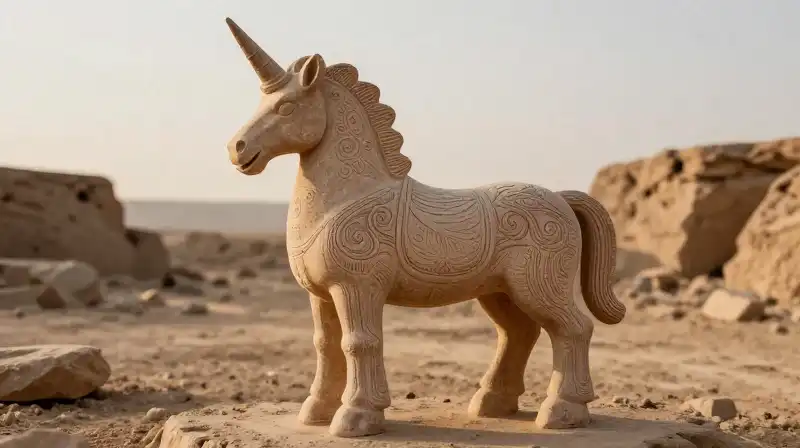
The earliest documented appearances of unicorn motifs predate the European medieval obsession with purity, grounding the tradition in much older regional contexts. The idea of a formidable, single-horned creature first appeared on soapstone seals belonging to the Bronze Age Indus Valley Civilization. In this early context, the depiction portrayed a bovine figure, which scholars interpret as a powerful emblem of a specific “clan or merchant community” 1. This suggests that, in its earliest form, the unicorn was less a creature of the wilderness and more a marker of social and economic strength.
As cultural exchange expanded, the motif traveled west. In Classical antiquity, Greek writers documented the existence of such creatures. Ctesias, for instance, described these animals in reports of India, noting their remarkable swiftness and the presumed value of their horn, classifying them as “wild asses” inhabiting a fabulous realm (1, 2). Later, Roman naturalists provided a more formal classification, naming the one-horned beast *monoceros*. They described it as a fierce animal with features reminiscent of a stag, possessing a single black horn (1, 2). These initial encounters presented the creature primarily as a biologically unique, powerful, and exotic beast.
The Christian Allegory and Spiritual Transformation
The most dramatic transformation of the unicorn occurred within European culture during the Middle Ages. The creature migrated from being a biological wonder into a potent theological and Christian allegory. Medieval texts, such as the *Physiologus*, reframed the unicorn’s narrative purpose entirely (1, 2).
The central piece of this new tradition was the lore surrounding its capture. The belief that a unicorn could only be subdued by a pure maiden became a cornerstone of the narrative. This concept provided powerful spiritual parallels: the maiden’s purity symbolized the Virgin Mary, while the successful, irresistible pursuit of the unicorn symbolized the Incarnation—Christ’s divine relationship with His mother (1, 3). The unicorn thus became a theological representation of divine irresistible might, a view reinforced by thinkers like Saint Basil within the tradition of Christian bestiaries 1.
Symbolism: Purity, Poison, and Pursuit
Beyond theological allegories, the unicorn held immense practical and symbolic value rooted in its supposed natural properties. Historically, the horn was highly coveted due to its perceived medicinal qualities. It was widely believed that the unicorn’s horn possessed the remarkable ability to render poisoned water potable and to absorb various poisons (1, 2). This belief cemented its status as a valuable, almost miraculous, substance.
These symbolic associations branched out into the realm of human emotion and courtly love. In European courtly traditions, the unicorn’s rarity and wild nature were adopted as powerful emblems for romantic devotion. The pursuit of the unicorn was often used as a metaphor for the lover’s passionate and singular desire for the virgin 1. Furthermore, while often linked to chaste love, the unicorn’s older scriptural references, such as the passage found in the Book of Job, simultaneously highlighted its untamable, immense, and formidable strength (1, 2).
Art and Cultural Preservation
The spiritual and material value of the unicorn was made visible and permanent through artistic traditions. The highly prized horns, although later identified by modern scholars as narwhal tusks, were stored in the most prestigious locations, such as the royal treasury of Westminster Abbey and the treasury of Saint-Denis, underscoring their cultural importance (1, 2).
For medieval audiences, visualizing this complex tradition was essential. The intricate “Hunt of the Unicorn” tapestry series served as a medium through which the public could engage with the creature’s symbolic life. These artworks did not simply depict a wild animal; they functioned as narrative devices that allowed viewers to contemplate the creature’s inherent spiritual significance, untamability, and the tension between the wild and the pure 1.
Conclusion: Decoding the Myth
The unicorn is a testament to the enduring human need to find meaning in the marvelous and the untamable. Its journey from a symbol of commercial power in the Indus Valley to a powerful metaphor for divine perfection and romantic pursuit in medieval Europe shows that cultural significance is dynamic, not static. While there remains scholarly debate regarding the precise link between the initial bovine figure and later European interpretations 1, the tradition itself has proven highly adaptable. For a reader seeking to understand the unicorn, the true value lies in recognizing its layered identity: it is simultaneously a marker of ancient community, a fierce natural wonder, and a profound spiritual standard of purity and strength.
References
Footnotes
Related Articles