
The Deepavali Tradition: Meaning, History, and Five Days of Light

Introduction
Deepavali, commonly translated as the “festival of lights,” is more than just a colorful celebration across the Indian subcontinent and its diaspora; it is a profound cultural, spiritual, and historical bridge connecting ancient practices to contemporary life. While often understood through the lens of Hindu mythology—symbolizing the victory of knowledge over ignorance, or *Dharma* over *Adharma*—its traditions are a shared cultural inheritance.
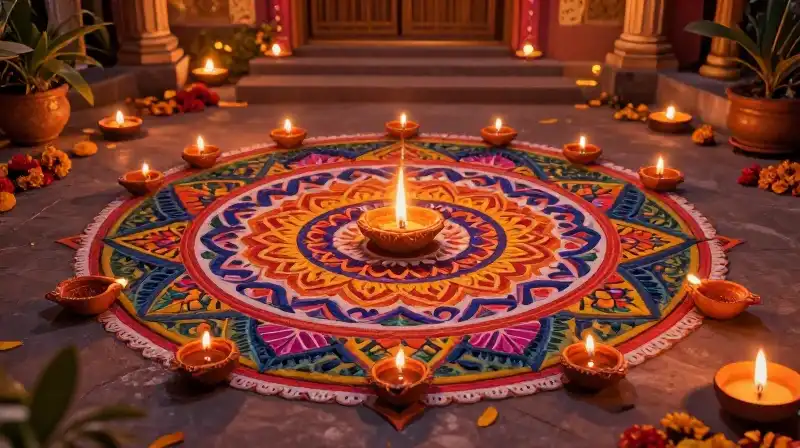
This celebration typically spans five or six days, occurring during the Hindu lunisolar months of Ashvin and Kārtika, generally falling between mid-October and mid-November (1, 2). By illuminating homes, temples, and workspaces with *diyas*, candles, and lanterns, participants are enacting a literal representation of internal light and hope, transforming public and private spaces into reflections of inner clarity and well-being (1, 2).
The Tapestry of Tradition: Who Celebrates and Why
A crucial aspect of understanding Deepavali is recognizing that its cultural practice transcends a single religious identity. While it is centrally recognized as a Hindu festival, the tradition has been adopted and adapted by adherents of Jainism and Sikhism, each celebrating distinct cultural and religious milestones (1, 2).
For Sikhs, the celebration often honors the release of Guru Hargobind, while for Jains, it commemorates the liberation of Mahavira (1, 2). This variation demonstrates the festival’s ancient capacity for assimilation and shared heritage. Historically, Deepavali may have begun in ancient India as a fusion of various harvest festivals 1, predating its current religious connotations. Early references to these grand celebrations in Sanskrit texts date back to the 7th and 10th centuries 1. Historical accounts, such as those kept by traveler Al Biruni, even documented the traditional spectacles of the holiday far outside the Indian subcontinent during the New Moon in Kartika 1.
Navigating the Five Days of Light: Ritual and Focus
The multi-day structure of Deepavali is not arbitrary; each day has a specific ritual and thematic focus that guides community activity and worship 1. This sequence allows families to progress through stages of spiritual and material renewal.
The festivities traditionally begin with Dhanteras, a day designated for welcoming wealth and signifying auspicious beginnings 1. This is followed by Kali Chaudas, which traditionally focuses on the purification of the environment and the purging of negative energy 1. The climax of the festival is the main day, devoted to Lakshmi Puja, the veneration of the goddess of wealth and prosperity 1.
The subsequent days often include Govardhan Puja in North India and Bali Pratipada in the South, illustrating how the core spiritual narrative unfolds with significant geographical variation across the subcontinent 1.
Beyond Lakshmi: Diverse Deities and Regional Nuances
While the worship of Lakshmi remains a unifying theme across much of the country, regional Hindu traditions exhibit rich diversity in their focus (1, 2). In some parts of Eastern India and Bangladesh, the ritual devotion centers more significantly on the goddess Kali, while other traditions focus on the worship of Shiva or Durga (1, 2).
Furthermore, Deepavali incorporates specific mythological narratives that vary by locale. For instance, some communities observe the day as marking the triumphant return of Rama to Ayodhya following his victory over Ravana. Other narratives connect the festival’s themes more closely to the divine activities of Vishnu, Krishna, and Hanuman (1, 2). This pluralism ensures that the tradition remains a deeply personal and regionally specific cultural experience.
Historical Context: Social Fabric and Tolerance
The cultural practice of Deepavali has always existed within a complex social and political landscape. Its history is marked by both periods of accommodation and conflict 1. For example, certain Mughal emperors, most notably Akbar, participated in the Deepavali festivities, reflecting a period of cultural synthesis. Conversely, other reigns saw the tradition banned, highlighting the multifaceted nature of the relationship between faith, state, and community practice 1.
From a human perspective, the festival functions fundamentally as a time of homecoming. It is a vital period for community bonding, involving elaborate feasts, the exchange of *mithai* (traditional sweets), and the honoring of ancestral lineages (1, 2). This strong emphasis on family ties and ancestral reverence reinforces its role as a vital marker in the cultural calendar, beyond mere religious observance.
Understanding Modern Celebrations and Community Life
Beyond the traditional rituals and five-day structure, the “Deepavali traditional” experience has broadened considerably due to global migration and the expanding reach of the digital age (1, 2). In modern times, the celebration has evolved to include international diaspora communities and has gained recognition as a public holiday across various countries (1, 2).
The focus today remains anchored in the core symbols: the act of illumination, the gathering of family, and the celebration of the return of goodness. However, modern practices often incorporate these ancient traditions into globally accessible forms, ensuring the story of light and knowledge continues to resonate across different cultures.
Clarifying Common Cultural Questions
Deepavali is frequently the subject of misunderstandings due to its broad adoption across multiple faiths and cultures. To provide clarity:
- Is Deepavali Indian or Hindu? It is a tradition deeply rooted in Indian culture. While it is a major Hindu festival (the “festival of lights”), it is also celebrated by adherents of Jainism and Sikhism, meaning it is a shared cultural tradition rather than being exclusive to one religion (1, 2).
- What are the five rules of Diwali? There is no single set of “rules” dictated by an outside body. The five-day structure refers to the sequence of significant rites and spiritual themes (Dhanteras, Kali Chaudas, and the main Puja days), which serve as guidelines for practice rather than mandatory laws.
In conclusion, the Deepavali tradition is a living cultural practice. It moves far beyond the definitions of religious texts or mythological narratives. It is a complex, regional, and human experience—a collective effort to honor ancestral bonds, celebrate community, and consciously embody the spiritual belief that light, even in the darkest times, will prevail (1, 2).
References
Footnotes
Frequently Asked Questions
What are the five rules of Diwali?
There is no single set of rules for Diwali dictated by an outside body; instead, the five-day structure refers to the sequence of significant rites and spiritual themes. These days, such as Dhanteras and Kali Chaudas, serve as guidelines for practice rather than mandatory laws.
Is Deepavali Indian or Hindu?
Deepavali is a tradition deeply rooted in Indian culture that is centrally recognized as a Hindu festival. However, it is also celebrated by adherents of Jainism and Sikhism, meaning it is a shared cultural tradition rather than being exclusive to one religion.
Related Articles