
Minerva: Defining the Roman Goddess of Wisdom and Strategy

Introduction
Minerva, while fundamentally rooted in the Roman pantheon, was far more than the simple goddess of wisdom. To understand her significance is to appreciate a profound cultural syncretism—the fluid way Romans adapted and merged traditions. She is widely equated with the Greek goddess Athena, demonstrating a rich blending of Italic and Hellenic influence (1, 2). At the heart of the Roman religious life, Minerva occupied a vital space within the Capitoline Triad, alongside Jupiter and Juno (1, 2). However, her role defied a singular label. She was understood as the patron of strategic warfare and tactical genius, an intellect that mastered the battlefield before the first blow was even struck (1, 2). By exploring her diverse domains—from the weaving shuttle to the military campaign—we begin to understand the deep connection she held in Roman communities to productivity, intellect, and mastery.
The God of Strategic Mastery
While she is often grouped with figures of knowledge, Minerva’s relationship with conflict is complex. She was not a deity associated with raw, physical violence, but rather one of strategic warfare (1, 2). Her presence in Roman communities was tied to the rigorous discipline of intellectual superiority in conflict. This strategic focus reached its height during the Quinquatria, her primary five-day festival in March, when Roman armies sought her guidance for the upcoming campaign season, hoping to attain her sharp tactical wisdom 1. Her divine spark was seen in the actions of great heroes; the myth recounts how Odysseus, or Ulysses, received a divine spark for his ingenuity when devising the Trojan horse, illustrating her role not as a fighter, but as the ultimate source of inspiration and stratagem 1.
A Patron of the Artisan and Merchant
The breadth of Minerva’s influence extends far beyond the battlefield. As a patron of arts, trade, and crafts, she was highly revered by a diverse segment of Roman society, including merchants and artisans (1, 2). This reverence reflects a deep cultural value placed on human productivity and intellect. This connection is powerfully evidenced in the sanctuary at Lavinium. Archaeological evidence from this community reveals the local devotion through specific votive offerings, including loom weights (1, 2). These finds confirm her patronage over weaving and various forms of artisanship, transforming her from a distant figure of battle into a protector of daily craft and economic success.
Nuances of Worship: Regional Variations and Origins
The worship of Minerva was not monolithic; its local expressions reveal the layers of cultural history present in the Roman world. One of the most significant layers of her identity involves her regional variations. In certain communities like Lavinium, she was uniquely linked to the guardianship of young women transitioning into marriage and motherhood, a role supported by the discovery of terracotta statues and ritual objects (1, 2). This depiction as a protector of life stands in contrast to the modern perception of Minerva as a strictly virgin goddess 1. Furthermore, the identity of Minerva itself suggests a deep connection to Italic traditions prior to her integration into the fully developed Indo-European mythology. It is speculated that her name may have cultural roots in Etruscan deities, such as Menrva, showing that her presence was built upon shared Italic heritage (1, 2). Her role as a “transfunctional goddess”—encompassing warfare, priesthood, and even agricultural activity—reflect a broader cultural necessity in the Roman world to unify these essential elements of life 1.
Minerva and the Manifestation of Divine Knowledge
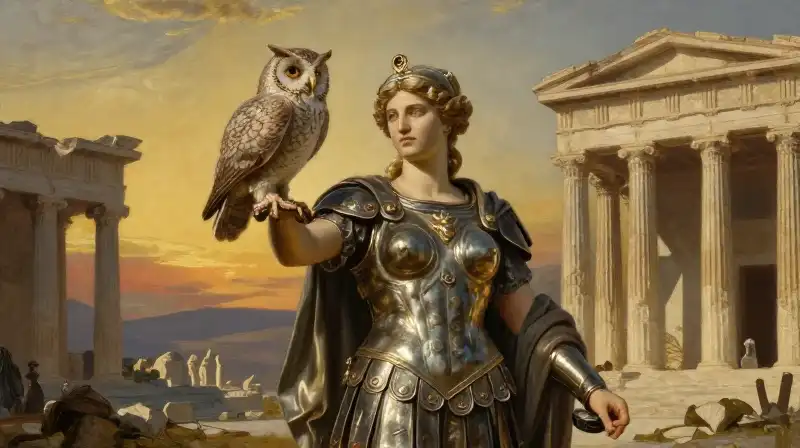
The practical application of Minerva’s wisdom was often channeled through the physical manifestations of her worship. One key aspect of her divine sphere involved healing; the dedicated temple situated on the Esquiline Hill featured anatomical votives, suggesting she was revered for her medicinal aspects and ability to understand the physical world (1, 2). Symbolically, the goddess was most frequently depicted in full armor, carrying a spear, yet her most enduring symbolic animal remained the owl. The owl represented her profound association with knowledge and the wisdom to “see” what others could not (1, 2).
Addressing Common Inquiries About the Goddess
Minerva vs. Athena: A Cultural Comparison
While the Romans and Greeks shared a common deity, the cultural emphasis differed. While the Greek Athena was consistently portrayed as a strict virgin deity avoiding procreation, the Roman Minerva, particularly in certain regional contexts, was viewed as a protector associated with childbirth and the protection of women 1. This nuance highlights how local Roman culture interpreted the grand archetype of the intellect.
Why is Minerva Important in History?
Minerva’s importance lies in her embodiment of the synthesis between intellect and action. She represents the idea that strategic thought, technical skill, and artistic excellence are the true markers of sophisticated civilization. She validates the value of the clever architect and the masterful weaver as much as the victorious legion.
Synthesis: The Intellectual Imperative
Minerva stands as a powerful reminder of the cultural concept of the “transfunctional goddess,” an archetype that bridged many perceived gaps in the ancient world. She is not merely a static representation of wisdom, but an active force that demands strategic preparation, technical skill, and the intellectual drive to improve community and military life. Understanding Minerva is therefore not simply about defining a Roman deity, but appreciating the multifaceted worldview of the Romans—one where the strategic genius of the weaver was as respected as the sharp eye of the general.
References
Footnotes
Frequently Asked Questions
Can I name my kid Minerva?
The provided article discusses Minervas roles, attributes, and religious significance in Roman history but does not contain any information regarding modern naming conventions or the suitability of the name Minerva for a child.
Why is Minerva important?
Minervas importance lies in her embodiment of the synthesis between intellect and action, representing strategic thought, technical skill, and artistic excellence as the true markers of sophisticated civilization. She validates the value of the clever architect and the masterful weaver as much as the victorious legion.
Related Articles