Anubis: Exploring the Mythology and Power of the Egyptian God

Introduction
Anubis is not merely a figure in an ancient pantheon; he is the personification of the most profound Egyptian journey: the transition between life and the eternal cycle of the afterlife. For the Ancient Egyptians, he was far more than a god of death; he was the vital facilitator of rebirth, a necessary guide for the deceased, and a symbol of the transformative power inherent in both life and passing. Central to the cultures that birthed him, Anubis occupied a unique place as the protector of graves and the keeper of the underworld (1; 2). His stories reflect a deep cultural preoccupation with how one transitioned into the next form of existence, a quest for order and preservation that defined the Old Kingdom and Early Dynastic periods.
The Custodian of the Sacred Passage
The primary function of Anubis was deeply rooted in the practical and spiritual realities of Egyptian funerary rites. According to 2, he was instrumental in the care of the deceased, holding preeminent status as the lord of the dead during the time of the pyramids. This was not a passive watch; Anubis was an active participant in the journey. He is intrinsically linked to the art of embalming—a process some sources (1; 2) suggest he pioneered, first applying it to the body of Osiris. This association shows that he was seen not just as a passive guide, but as the patron of the critical ritual processes required for a soul to remain intact and recognizable in the next world.
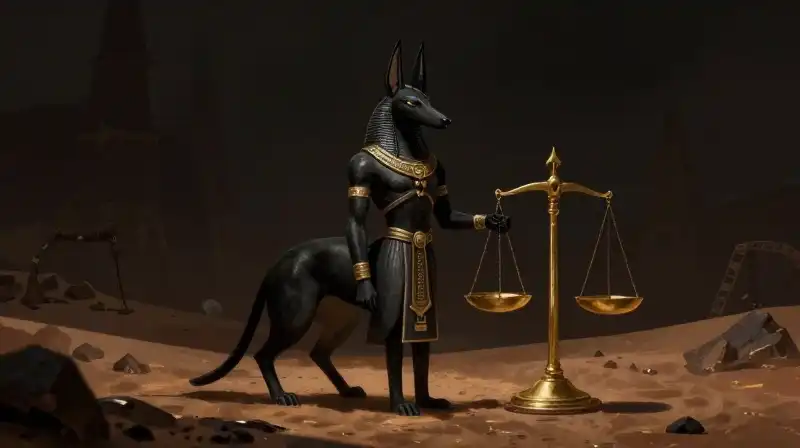
His most famous narrative role is his role in overseeing the “Weighing of the Heart” ceremony. This moment, central to Egyptian belief, was the ultimate test of a soul’s morality. Anubis, in his capacity as the overseer, ensured that the individual’s heart was correctly weighed against the feather of truth, determining their passage into the afterlife 1. This act placed him as a supreme judge within the spiritual hierarchy, cementing his reputation as a protector and a guide who ensured cosmic balance.
The Aesthetics of Transformation and Regeneration
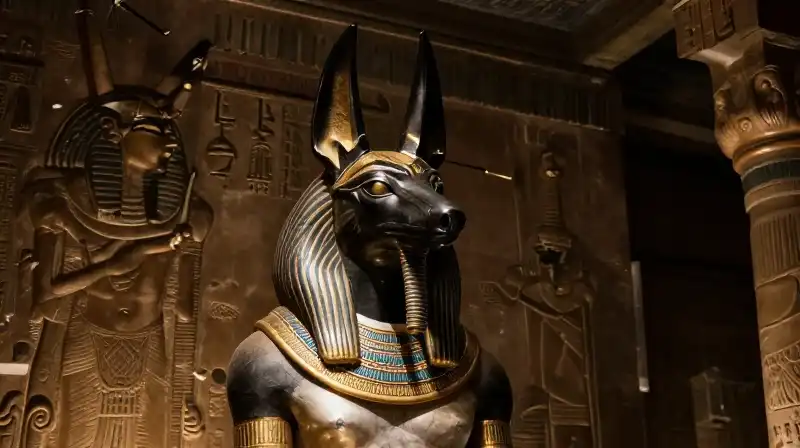
The visual and symbolic representation of Anubis is as rich as his mythology. Typically depicted as a man with a canine head, or sometimes in the form of a jackal, this visual style originated from ancient observations of jackals scavenging near cemeteries (1; 2). But the meaning of his form runs deeper than mere biological observation; it ties directly into the concept of transformation.
A particularly rich cultural nuance is his association with the color black. As noted in competitor analyses and cultural interpretations, Anubis was almost always depicted in shades of black (1; 2). This color was not merely a visual choice; it held profound cultural meaning. It represented regeneration, the life-giving black soil of the Nile, and the process of transformation that occurs during the critical stage of embalming 1. This reinforces the idea that while Anubis presided over death, he was fundamentally a deity of new beginnings and the cycle of eternal return.
The Shifting Divinity: Anubis Through History
The story of Anubis is one of constant adaptation and change. His role did not remain static throughout the Egyptian millennia. During the Middle Kingdom, for example, his authority as the primary lord of the underworld was subtly shared with or supplanted by Osiris (1; 2). This suggests that as Egyptian theology matured, the focus shifted between the practical duties of the guide (Anubis) and the ultimate sovereignty of the resurrected king (Osiris).
Later periods saw Anubis undergo significant syncretism, or the merging of deities. During the Ptolemaic era, he became intertwined with the Greek god Hermes, resulting in the composite figure Hermanubis. Both deities shared the crucial role of guiding souls (1; 2). This cultural shift demonstrates how ancient traditions influenced and were influenced by surrounding regional cultures, making him an evolving figure in the broader Mediterranean spirit.
In the subsequent Greco-Roman era, his influence extended to the Western mythological frameworks, integrating him conceptually with the underworld figures of Hades and the beast Cerberus 1. His mythological lineage is also varied; while most commonly recognized as the offspring of Osiris and Isis, other traditions suggest he may have been connected to Ra or even the cat-headed Bastet 1. This variation highlights the fluid nature of ancient folklore, where powerful archetypes often assumed multiple narrative forms.
Who Holds the Higher Place in the Hierarchy?
Addressing the question of hierarchy requires looking at the scope of his duties rather than a simple vertical ranking. Anubis was the master of the *journey* and the *judgment* process, but his ultimate place depended on the pantheon and the era (1; 2). If we examine the primary centers of power in Egyptian theology, the figure of Osiris represents a more sovereign, regal authority, especially regarding the afterlife and resurrection, often taking the role that Anubis previously dominated (1; 2).
Furthermore, in periods of syncretism, like his melding with Hermes, he becomes a specialized, powerful *guide* rather than the supreme ruler. Ultimately, Anubis functions as the essential facilitator of the cosmic order; he is not necessarily “higher” than the gods of creation, but he is the critical hinge through which every mortal soul must pass to achieve eternal life.
The Living Resonance of the Osirian Narrative
While Anubis is an ancient figure, the cultural narrative of his life—specifically the adoption by Isis after she found his abandoned baby, aided by dogs—continues to be a potent myth that integrates him into the Osirian pantheon 1. This narrative of maternal care and subsequent integration into a royal family mirrors the enduring human desire for belonging and protection.
Today, the tradition lives on less in rigid religious practice and more in symbolic representation and cultural appreciation. The Anubis motif, once a sacred sign of preservation and passage, continues to resonate in modern arts, tattoos, and even general iconography as a symbol of transformation and mastery over the complexities of transition. This legacy reminds modern readers that Anubis was never just a god of death, but a profound metaphor for how a civilization understood the continuous cycle of change and the necessity of facing one’s own journey toward renewal.
References
Footnotes
Frequently Asked Questions
Who is higher than Anubis?
According to the article, the figure of Osiris represents a more sovereign and regal authority in Egyptian theology, especially regarding resurrection and the afterlife. During certain periods, such as the Middle Kingdom, Anubiss authority as the primary lord of the underworld was shared with or supplanted by Osiris.
Related Articles