Greek and Roman God Names: How the Pantheons Compare

Introduction
The tradition of the Greek and Roman pantheons offers a profound lens into the collective imagination of Western civilization. Far from being a mere collection of names, these divine systems represent complex cultural narratives—stories that shaped how ancient communities understood the cosmos, morality, law, and the very nature of being. A “pantheon” is, fundamentally, the collection of deities within a polytheistic tradition 1. For a reader interested in “Greek and Roman god names,” the exploration goes beyond simple matching of figures; it is an inquiry into a long-standing cultural dialogue—how one ancient worldview absorbed, mirrored, and transformed another, creating a richly interwoven tapestry of belief.
The Primordial Origin: From Chaos to Olympian Order
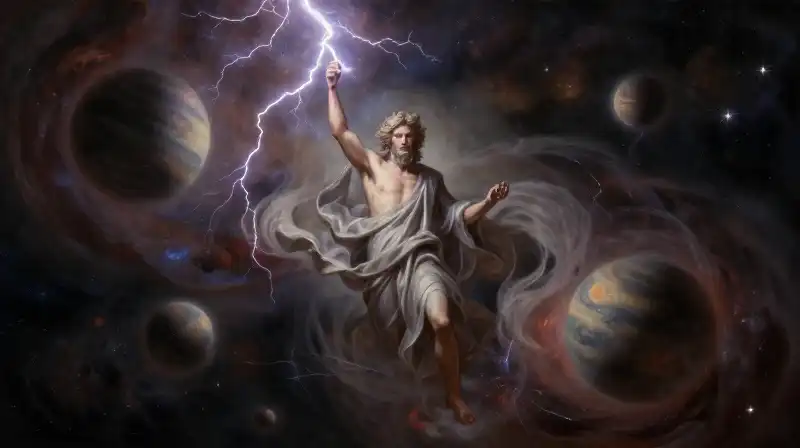
To understand the later Olympian structures of Zeus and Jupiter, one must first understand the foundational cosmology of the tradition. Greek belief posits a cosmos beginning with Chaos, the unformed void. From this arose Gaia, the primal Earth, who, in turn, gave birth to Ouranos, the primordial Sky, along with other foundational entities 1. This lineage established a tiered hierarchy, moving from monstrous, primal creators to the sophisticated figures of the Olympians. The early divine order was maintained by the Titans, led by figures like Cronos and Rhea. This era of immense, foundational power was eventually challenged and superseded by a new generation of gods who established a more organized celestial rule. Zeus emerged as the supreme ruler, eventually forming the core of the Olympian gods 1. This progression from primordial chaos to a structured royal family reflects a deeper human desire to impose order on the uncontrollable forces of nature and existence.
The Art of Syncretism: A Cultural Dialogue Between Two Civilizations
The relationship between the Greek and Roman traditions is not one of replacement, but often one of sophisticated assimilation. This process is known as syncretism, and it is perhaps the most telling sign of the cultural interaction between these societies. Syncretism describes the merging of existing deities—either native Roman gods being blended with their Greek counterparts or, as seen in other examples, Greek and Roman gods being merged with Egyptian divine forms 1. This merging resulted in complex divine personalities. For instance, the revered goddess Venus is often seen as a blend of Aphrodite (the Greek), alongside influences from powerful Egyptian goddesses such as Isis and Hathor 1. This demonstrates that these pantheons were not isolated systems; they were living, evolving frameworks that drew inspiration from wider cultural spheres, particularly those along the Mediterranean trade routes. While some scholarly discussions treat the systems as interchangeable variants, other researchers suggest that certain key deities, like Jupiter, may predate the spread of Greek colonization, potentially deriving from a broader Proto-Indo-European archetype of a sky father 1. This suggests that even in the process of comparison, there are layers of deep, ancient continuity underneath the surface.
Distinguishing Attributes: The Nuances Beyond the Name Match
Despite the common pairings—such as Zeus/Jupiter or Poseidon/Neptune—it is crucial to understand that these deities were not mere synonyms. While their names varied regionally or linguistically (2, 3), their attributes, roles, and associated symbols maintained distinct cultural significance. For example, both Athena and Minerva (their Roman counterpart) are revered for wisdom, but their domains also encompass warfare, showcasing the duality of civilization. Similarly, Hermes and Mercury function as messengers, but their roles extend to being psychopomps—guides of souls—and associated with trade 1. Iconography served as a visual language for these gods. Poseidon or Neptune is intrinsically linked to the trident and the sea; Juno or Hera is symbolically linked to marriage and often symbolized by the peacock (1, 2). This emphasis on distinct attributes—the thunderbolt of Zeus, the tridents of the water god—highlights how the culture used specific symbols to differentiate power and domain, even when the general archetype of the “king of the gods” was shared (1, 2).
The Scope of Power: Rulers and Guardians of Order
The pantheons provided a blueprint for the societal structures themselves. Figures like Zeus or Jupiter are culturally understood as the kings of the gods, wielding authority over fundamental concepts such as law, order, and the element of thunder (1, 2). Their dominion represented the highest form of cosmic regulation. However, the pantheon was not solely about the celestial heights of the gods. It included powerful figures who governed the borders between life and death. The ruler of the underworld, Hades in Greek mythology, was known by various names in Latin adaptations, such as Dis, Pluton, or Pluto (2, 3). These underworld figures, along with those controlling the sea or the fields, demonstrated the comprehensive nature of the divine jurisdiction—covering every aspect of human experience, from civic law to the fate of the soul.
The Cultural Weight of Language and Naming Conventions
The nomenclature itself carries cultural baggage. One common point of discussion among scholars and enthusiasts is whether there are linguistic rules dictating naming conventions 1. Historically, some observations suggested male names often concluded in consonants and female names in vowels 1. Regardless of specific linguistic rules, the choice of which nomenclature to use—Greek or Latin—often reflects the personal narrative of the person engaging with the myths. Some adherents prefer Greek names because they are associated with the traditional narratives of the myths, while others use the Latin forms for regional familiarity or ease of study 1. The various regional forms of names (e.g., Hades versus Dis) prove that “Greek and Roman god names” are not fixed historical data points, but rather dynamic linguistic adaptations that evolved as cultures met and merged.
Living Traditions and Contemporary Understanding
The myths of the Greek and Roman pantheons remain a cornerstone of cultural heritage, providing foundational stories that help us understand how humans navigate power and change. For contemporary readers, understanding these comparisons is an exercise in cultural empathy. It reveals not just a list of names, but a sophisticated ancient worldview where gods were both mirrors of human societal values—law, trade, wisdom—and representations of the terrifying, sublime forces of nature itself. The enduring value of these traditions lies in their complexity. They show that culture does not grow in isolation; rather, it thrives through interaction, exchange, and transformation. To study the names and functions of these gods is to study the very processes of human civilization: how societies define law, how they express fear of the unknown, and how they choose to create shared stories that bind communities together.
References
Footnotes
Related Articles