Höðr in Norse Mythology: From Passive Victim to Aggressive Warrior

Introduction
To understand the Norse figure of Höðr is to confront the complexities of historical preservation and cultural storytelling. Höðr is not merely a character in a saga; he is a complex nexus where myth, history, and literary evolution collide. While modern interpretations sometimes simplify him, reducing him to a peripheral figure in the story of Baldr’s death, a closer look reveals a character whose identity is deeply contested—shifting from a passive, unwitting participant to a fiercely defined warrior across different eras of literature. For those seeking to understand Norse mythology beyond a simple checklist, Höðr represents the challenge of interpreting ancient narratives that were often recorded long after their original events, leading to conflicting portraits of the same divine being.
The Conflicting Portrayals: Snorri Versus Saxo
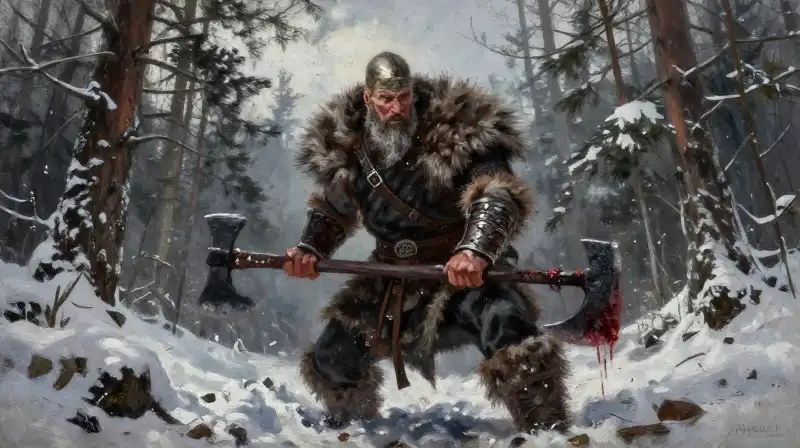
The primary source material defining Höðr contains a fascinating dichotomy, which scholarly study often highlights (1, 2). These variations are often attributed to the differing styles and purposes of the writers who chronicled the ancient stories. Snorri Sturluson, author of the *Prose Edda*, presents a specific narrative thread that frames Höðr as a vulnerable, somewhat gullible figure. In this telling, Höðr is not a proactive participant in the celestial tragedy but a victim of Loki’s clever deception (2, 1). Conversely, Saxo Grammaticus, in his *Gesta Danorum*, introduces a fundamentally different portrait of Höðr (also Latinized as Hotherus) (1, 2). Saxo’s Höðr is a formidable warrior, a man defined by his very nature and a specific name meaning “Warrior” or “Battle” (1, 2). In this version, Höðr is a proactive, aggressive leader who seeks powerful magical weaponry to confront Baldr. This discrepancy reveals a key insight into Norse literature: the historical record demonstrates a clear tendency for later writers to “fill in the gaps” of primary sources, resulting in competing interpretations of a single figure 1.
The Fate and Symbolic Role of Höðr
Regardless of whether he is viewed through the lens of Snorri’s trickery or Saxo’s martial prowess, both major narrative traditions agree on the eventual conclusion of Höðr’s life (1, 2). He is ultimately slain by Váli, a character who is uniquely conceived by Odin to serve as Baldr’s avenger (1, 2). The function Höðr plays within the wider cosmic narrative is also significant. His initial appearance in the *Gylfaginning* (the Proving of Lies) is delivered ominously, suggesting that the “work of his hands”—whether through the accidental shooting of the mistletoe arrow or through his martial endeavors—would be held in memory amongst both gods and men long after his death 1. Further complicating his post-death existence, Snorri’s work places his later appearance in the world of Hel 1. To describe this figure, Snorri employed powerful kennings—such as ‘Blind God,’ ‘Baldr’s Slayer,’ and ‘Thrower of the Mistletoe’—though these epithets were notably absent from extant skaldic poetry 1.
Addressing Common Questions and Misunderstandings
The image of Höðr is often muddled by modern speculation or simplified summaries, leading to several persistent misunderstandings 1. It is important to address some common inquiries that frequently arise when exploring his mythology.
- Who is Höðr? Fundamentally, Höðr is a Norse deity whose most known narrative is tied to the fateful death of Baldr, the blind son of Odin (1, 2).
- What is Höðr the god of? While some later cultural discussions have attempted to specialize him as a god of darkness or winter, it must be noted that there is no surviving mythological source material to substantiate such a definitive claim 1. Scholars advise caution when assigning specific attributes to Norse figures based on modern interpretations.
- Who killed Höðr? Höðr was slain by Váli, a figure specifically created by Odin to fulfill the role of avenging Baldr (1, 2).
While there is curiosity regarding associated elements like Höðr’s wife, weapon, or powers (related searches), the core of his established mythology revolves around his tragic role in the timeline of the cosmos and the struggle between fate and free will.
The Endurance of the “Living Culture”
In the context of the cultures that have preserved Norse heritage, Höðr serves as a reminder of the deep human need to contextualize tragedy. His character demonstrates that mythological figures are not static symbols, but rather evolving vessels for cultural memory. As we look at the traditions, we see the transformation of a figure from a victim of fate (the passive character of Snorri’s telling) into an embodiment of action and destiny (the warrior of Saxo). Ultimately, to understand Höðr is to understand the act of interpretation itself. He forces the reader to consider the biases of the chroniclers and the dynamic nature of folklore. Instead of accepting a singular definition, the tradition invites us to see the layered complexity: the simultaneous victim, the aggressive force, and the historical product of later literary genius. Through these diverse narratives, Höðr remains a testament to the richness and contradiction of a world where stories are never truly finished.
References
Footnotes
Frequently Asked Questions
What is Hod the god of?
There is no surviving mythological source material to substantiate definitive claims that Höðr is the god of darkness or winter.
Who killed Hod in Norse mythology?
Höðr was slain by Váli, a character who was uniquely conceived by Odin to serve as Baldr’s avenger.
Who is Hod in mythology?
Höðr is a Norse deity whose most known narrative is tied to the fateful death of Baldr, the blind son of Odin. He is portrayed differently across sources as either a vulnerable victim of Lokis deception or as a formidable warrior whose name means Warrior or Battle.
What happened to Hodr Norse mythology?
Despite differing portrayals of him as either a victim of deception or a fierce warrior, both narrative traditions agree that Höðr was ultimately slain by Váli, a character uniquely conceived by Odin to serve as Baldr’s avenger.
Related Articles