
Ancient Egyptian Priestesses: Ritual, Power, and Divine Duty

Introduction
Ancient Egyptian society often features a sweeping narrative of rigid gender roles, yet the lives of the women who served the temples reveal a dynamic and complex reality. Far from being relegated solely to private or domestic spaces, female priestesses were deeply integrated into the fabric of cosmic order and political life. In the world of ancient Egypt, these women were not merely ceremonial figures; they were often the “earthly hands and voices of the divine” 1. Their roles spanned a spectrum from highly devotional performances to powerful administrative leadership, demonstrating that the maintenance of *Ma’at*—the fundamental concept of cosmic harmony—required the unique skills, songs, and movements of women who acted as conduits for the gods.
The Many Faces of Sacred Duty
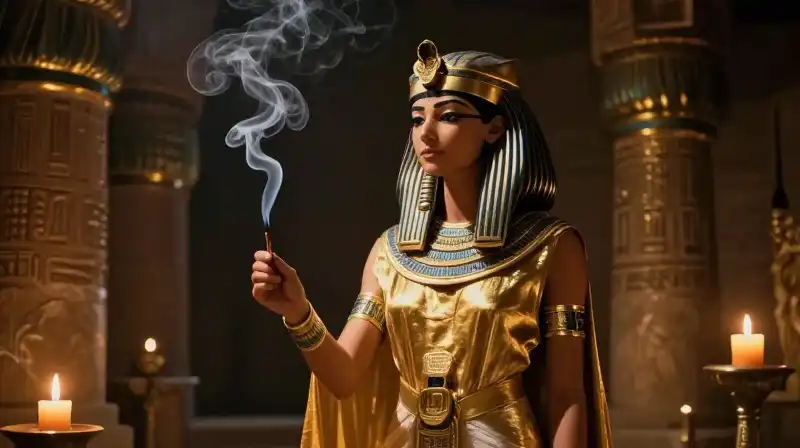
The duties performed by Egyptian women in the temple were varied, reflecting the diverse needs of the deities they served. These roles extended far beyond simple prayer, encompassing performance, administration, and practical craft. Consider the Priestess of Hathor, or Chantress of Hathor; her function was one of dual nature. She was expected to bring joy and beauty to the divine presence, yet she was equally vital in funerary rites, welcoming the souls of the departed to the afterlife 1. Many of these sacred roles required specialized skills that required women to be highly functional and professional. They were not only singers of sacred hymns and dancers meant to awaken and appease the gods, but they also performed tasks like raising delicate sistra (sacred rattles) 1. Furthermore, the temple was a center of production. Priestesses served as Temple Weavers and Perfumers, creating the essential sacred oils and fine linens needed for the elaborate divine offerings 1.
Ritual Performance and the Embodiment of the Divine
For the people of the Nile, the temple was the nexus where the mortal and divine worlds intersected. The functions of the priestesses were central to maintaining this spiritual continuity. Their songs, movements, and offerings were believed to embody and summon the divine presence within the land of Egypt 1. In funerary practices, women who served as lamenters were crucial to the spiritual tapestry. By performing sacred dirges at burials, they were believed to aid the deceased’s transition to the afterlife, assuming the roles of powerful maternal deities like Isis and Nephthys 1. This suggests that the Egyptian spiritual framework saw women as potent vessels capable of channeling complex emotional and sacred energies necessary for the soul’s safe passage.
Power, Status, and Administrative Authority
While their ceremonial roles were deeply rooted in devotion, the status and influence of these women were often political and professional. This reality challenges earlier scholarly misconceptions that viewed the roles of priestesses as merely honorary or based on external cultural biases 1. Titles held by women were often markers of immense power. A title such as “God’s Wife of Amun” represented a highly prestigious religious office. Women who held this position wielded considerable religious and political clout, sometimes commanding an influence that approached that of viziers or kings 1. The administrative capacity of women is also clear in historical records. The “Great Chantress of Amun,” for instance, was documented in letters where she sharply ordered officials to provide rations for the temple workers, demonstrating significant administrative authority 1. Furthermore, the *Meret* priestess held roles that involved overseeing the financial security and management of the temple’s real estate 1. These high-status positions were frequently borne by members of noble families, indicating that their status was often an inherent part of their lineage rather than simply a result of marriage to a male priest 1.
Addressing the Misconceptions: Duty vs. Taboo
Historically, the religious involvement of women has been overlooked or discounted by previous generations 1. In attempts to categorize their roles, some later historians made incorrect assumptions, suggesting that temple roles were purely sexual. However, modern scholarship has definitively refuted the notion of temple prostitution. The evidence shows that the duties of these priestesses were sacred, highly professional, and that sex was strictly forbidden within the hallowed walls of the temple 1. Beyond the strictly religious sphere, the Egyptian system provided evidence that the religious involvement of women was highly functional across all strata. Historical records indicate that lower-ranked female service workers, for example, were sometimes paid the same as their male counterparts 1. This points to a functional society where professional ability and service were valued and compensated, regardless of the sex of the individual.
Conclusion: The Enduring Significance of Female Leadership
The story of the Egyptian priestess is one of far more than just ritual; it is a testament to the intersection of spirituality, power, and domestic craft in ancient society. These women were the indispensable bridge between the earthly needs of the community and the divine expectations of the cosmos. Their roles prove that high status was accessible to women through specialized knowledge and dedication to the divine service. Understanding their practices requires looking past modern assumptions about gender roles to appreciate the rich, functional, and profoundly spiritual tapestry woven by these incredible women in the land of the Nile.
References
Footnotes
Frequently Asked Questions
What did Egyptian priestesses do?
Egyptian priestesses held highly diverse roles that spanned ceremonial performance, administrative leadership, and practical crafts, such as weaving and perfuming. These women performed sacred duties to embody the divine and welcomed the souls of the departed, while also holding significant authority that sometimes rivaled that of viziers or kings.
Related Articles