
Día de Muertos: Understanding the Mexican Celebration of the Dead

Introduction
Día de Muertos, or Day of the Dead, is not a mourning period in the Western sense; rather, it is a vibrant, joyous, and profound annual convergence of the worlds of the living and the deceased. Celebrated primarily on November 1 and 2, this festive multi-day tradition across Mexico and parts of the world serves as a powerful acknowledgment that death is not an ending, but a natural, fleeting phase of life. For participating communities, the holiday is a rich cultural practice where ancestors are invited back home, not to be feared, but to be welcomed back into the family circle. It is a celebration rooted in the belief that the spirits of the departed return to visit their loved ones, guided by the sights, scents, and prayers offered by the living.
The Sacred Geography of the Ofrenda
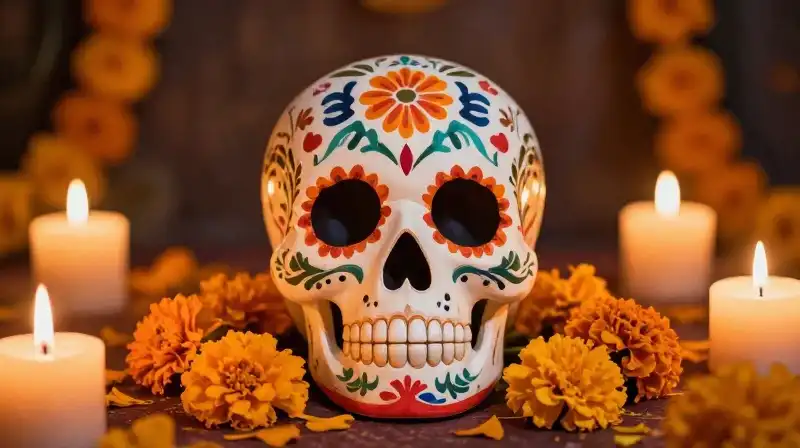
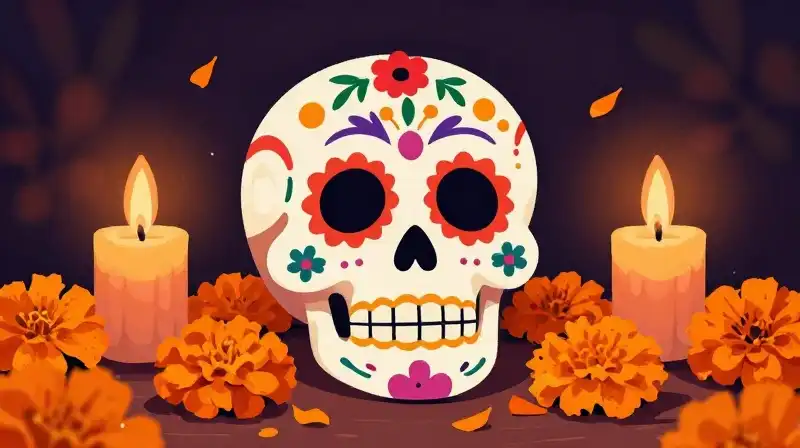
The heart of the Día de Muertos celebration resides within the home, centered around the creation of the ofrenda, or home altar. This elaborate display serves as a bridge between worlds. Families meticulously decorate their altars, filling them with symbolic offerings. A staple of these decorations is the marigold, cempazúchil, whose bright orange hue and strong scent are believed to guide the spirits back to the home (1, 2). Alongside the flowers, the altars are laden with the personalized favorites of the departed: the food, drinks, and photographs of those being remembered. The entire structure is an invitation—a way to ensure that the returning spirits are well-fed and happy, as the scents and prayers encourage their visits 1.
Beyond the domestic altars, the celebration spills out into cemeteries. On these days, families undertake the labor of cleaning, decorating, and tending to tombstones. The graves become gathering places where families feast, sing, and engage in lively conversation with their ancestors, merging the solemnity of the resting place with the warmth of a communal gathering 1.
Lightness, Humor, and the Symbolism of Death
What truly distinguishes Día de Muertos from other traditions of mourning is its pervasive sense of humor and celebration. Rather than being defined by tears, the culture integrates humor into the commemoration of the dead (2, 3). This is perhaps most evident in the widespread use of calaveras—sugar skulls or stylized skeletal figures. These figures are rarely depicted in a frightening manner; instead, they are whimsical, often placed in everyday scenarios, serving as a gentle reminder that death is an inevitable and natural part of the human experience 1.
This cultural spirit is further manifested in the tradition of calaveras literarias (literary skulls). These are satirical poems or light-hearted mock epitaphs. By satirizing the deceased or current community figures, participants embrace death with intellectual playfulness and acceptance, demonstrating that even in remembrance, cultural irony and humor are integral to the living culture 1. The famous image of La Calavera Catrina, the elegantly dressed skeletal woman, solidified this cultural embrace of death as sophisticated and artistic, though its modern imagery is rooted in the work of José Guadalupe Posada 1.
A Tapestry of Origins and Cultural Debate
The history of Día de Muertos is not a simple narrative but a complex tapestry woven from various influences. Academic discourse surrounding its origins is often divided. Some perspectives trace the tradition back to deep Indigenous Mesoamerican roots 1. However, others argue that the holiday is a sophisticated blend, resulting from the intersection of Indigenous ritual with Spanish Catholic traditions and later, 20th-century social adaptations 1. This blending is key to understanding the modern iteration of the holiday.
Scholars have historically examined the narrative of exclusive Indigenous origin, suggesting that what is seen today is also influenced by modern socio-political movements, such as what some academics refer to as a “Cardenist invention”—a mechanism used to foster and solidify Mexican national identity 1. Furthermore, the visual elements of the celebration, such as the stylized skeletal imagery, have been noted by researchers to have ties not only to ancient native rituals but also to European artistic traditions, including the Renaissance and the dramatic works of Goya 1.
The Living Practice: Keeping the Cycle Turning
The tradition is a continuous act of remembrance that spans the nights. This period of staying awake, known as velar, is a deep cultural habit that relates to specific historical mandates. Historically, the practice of keeping the altars displayed outside of churches is tied to the Reform Laws enacted under the presidency of Benito Juarez 1. This commitment to remaining awake through the night is a conscious act of presence, allowing the living to maintain connection with the spiritual presence of their ancestors throughout the duration of the celebration 1.
For readers seeking to understand the fundamental purpose of this celebration, it is a practice of honoring memory and celebrating continuity. It is a cultural method for integrating loss into the fabric of life, emphasizing that the bond between generations—the living and the deceased—is enduring. It moves beyond mere remembrance to an active, joyful engagement with the past that affirms the presence of those who came before us.
Synthesizing Meaning and Context
Día de Muertos is a living cultural artifact—a vibrant demonstration of how community and heritage shape lives around the globe. Its core meaning is found in the active, reciprocal relationship between the past and the present. It demands more from the participant than passive observance; it requires the hands of the creator, the heart of the host, and the imagination of the storyteller. For those navigating this tradition, whether through the famous imagery of La Calavera Catrina, the meticulously crafted *ofrendas*, or the spirited conversations in the cemeteries, the true significance lies in the joyful recognition that life and death are inextricably linked, and that the memory of one feeds the spirit of the other. It is a beautiful reminder that culture thrives not just in preservation, but in the dynamic, celebratory way communities choose to live with the complexity of existence.
References
Footnotes
Frequently Asked Questions
What is the Mexican celebration of the dead called?
Día de Muertos, or Day of the Dead, is the name of the vibrant, joyous, and profound annual celebration of the convergence of the worlds of the living and the deceased.
Related Articles