
Exploring Greek Kings Mythology: Legends of Fate and Power

Introduction
In the complex tapestry of ancient human tradition, the figure of the king has long served as a primary vessel for exploring the relationship between divine will and mortal agency. Greek kings mythology offers more than a catalog of powerful figures; it presents a profound meditation on the fragility of power and the relentless weight of fate. These are not merely leaders; they are mirrors reflecting the deepest cultural concerns of the ancient Greeks: hubris, the price of divine favor, the struggle against the monstrous, and the inevitable cycle of life and death. Understanding these kings means understanding a cultural narrative where every decree, every battle, and every tragic downfall is fundamentally an act of mythic consequence.
The Weight of Corrupted Divinity and Kingship
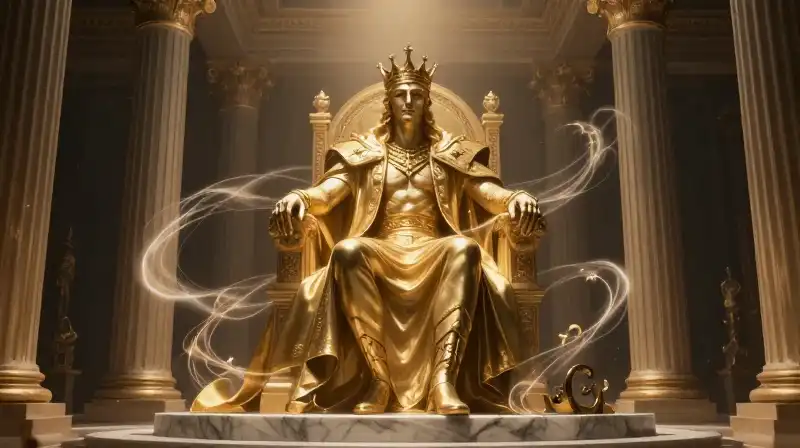
The Greek tradition often posits that a monarch’s fate is intrinsically linked to the favor, or the wrath, of the gods. King Midas, for example, exemplifies the corrupting nature of divine blessings. According to 1, his acquisition of a golden touch was a reward for a kind act—hosting the companion Silenus of Dionysus—yet this favor swiftly transformed into an inescapable curse, illustrating how the greatest gifts can become the gravest burdens. Similarly, the king’s actions can lead to transformations that define a tragic existence. King Lycaon, a ruler of Arcadia, was subject to divine judgment after slaughtering a child and offering it to a god, resulting in his horrifying metamorphosis into a wolf 2. These stories demonstrate that kingship in this tradition is not merely political, but a perilous pact with the supernatural.
Hubris and the Price of Royal Power
Many figures in Greek mythology are remembered not for their wisdom, but for their monumental failures of moral judgment—actions that challenge the cosmic order. King Tantalus, who attempted to present his own children as sacrificial offerings to the gods, serves as a stark cautionary tale 2. Later, the transgressions of Lycaon and Diomedes further underscore this theme. King Diomedes of Thrace was ultimately undone by Heracles after he committed the cultural transgression of feeding his horses on human flesh 2. The tradition suggests that the greatest power—whether military, physical, or inherited—is bound by a strict code; to break that code through arrogance or impiety is to invite devastating punishment.
The Intersect Between Kings, Gods, and the Underworld
Beyond the realms of mortal and divine retribution, the role of a king sometimes shifts into that of a judicial or foundational figure. Minos, for instance, shared a role with other powerful entities like Rhadamanthus and Aeaceus, serving as a king or judge of the underworld, which provides a crucial narrative lens for exploring divine or afterlife authority 2. This suggests that certain royal traditions transcend the temporal realm, acting as gatekeepers between life and death. Conversely, some kings are foundational myths themselves. Cecrops, described as an early king of Athens, is distinguished by a unique and unsettling physical attribute—a snake’s tail instead of legs—marking him as a figure of primordial mystery 2.
Tracing the Line: King vs. Hero vs. Divine Agent
When seeking to understand the sheer variety of these powerful figures, one must distinguish between a monarch and other mythic archetypes. The term “king” in this context often describes a figure of inherited, yet often flawed, political power, contrasted with heroes whose prowess stems from physical skill or divine favor. The narrative structure of these myths often requires both. For example, the monstrous Geryon required a divine labor from Heracles to defeat his fabulous herd, illustrating the struggle between human (or quasi-human) dominion and primordial chaos 2. Similarly, the figure of Kyknos, who served as a champion of the Trojans, often experienced sorrow and transformation after losses, embodying the tragic weight of a commander rather than just the absolute authority of a sovereign 2.
The Tragic Nexus: Family and Destiny
Perhaps the most potent theme surrounding these royal figures is the inescapable entanglement of family and destiny. King Agamemnon’s decision to sacrifice his own daughter to ensure favorable winds for the voyage to Troy is a narrative of profound ethical complexity, one that directly leads to his own catastrophic demise at the hands of his wife, Clytemnestra 2. This relationship between king and consorte serves as a powerful microcosm of the larger cultural concerns of betrayal and fate. The same sense of intense vulnerability and moral burden is felt by King Priam of Troy, who is depicted petitioning the hero Achilles to return the body of his son, a moment of desperate humility that moves even the most enraged warrior 2.
Defining the Scope: Who Were the Ancient Greek Kings?
To address the broader question of who these figures represent, it is important to understand that “the 7 kings of Greece” (or any specific number) is a modern simplification; the tradition is vast, regional, and fluid. Instead, we can classify these powerful individuals by the *function* they fulfill within the mythic worldview:
- The Tragic Monarch: Figures like Agamemnon and Oedipus, whose great power is undone by the complexity of their personal fate 2.
- The Judgement Figure: Kings like Minos, who bridge the gap between the living and the divine realms 2.
- The Punished transgressor: Those like Ixion (the Lapith king chained to a fiery wheel for attempting to rape Hera, 1) or Tantalus, who suffer eternal consequences for defying the natural or divine order (2, 1).
- The Primordial Ancestor: Figures like Deucalion of Thessaly, who survived a deluge sent by Zeus to recreate the human race, establishing a foundational narrative for the civilization 2.
Understanding the Living Culture of Myth
While these stories originate in a deep past, the tradition of Greek kings mythology remains a living part of cultural scholarship and artistic practice. These legends provide essential archetypes for storytelling that still resonate today. The exploration of a figure like Lycurgus, the Thracian king remembered for his madness and self-destruction after murdering his family following conflicts with the god Dionysus 2, highlights a persistent theme in storytelling: the dangers of overreach. The traditional stories are not static definitions; they are adaptable narratives—most powerfully evidenced by the fact that King Oedipus is cited as an immensely interesting figure whose complex fate lends itself to ongoing artistic adaptation 2. The tradition of these kings offers a unique perspective: power is rarely just about command; it is about enduring the weight of consequences. The ancient Greeks viewed these kings as living evidence that no matter how mighty a human might be, they remain subject to the overarching cycles of fate, divine oversight, and the inescapable gravity of their own choices.
References
Footnotes
Frequently Asked Questions
Who are the 7 kings of Greece?
The article states that the 7 kings of Greece is a modern simplification because the tradition is vast, regional, and fluid. Instead of specific names, the text classifies these powerful figures by the function they fulfill, such as the Tragic Monarch or the Primordial Ancestor.
Related Articles