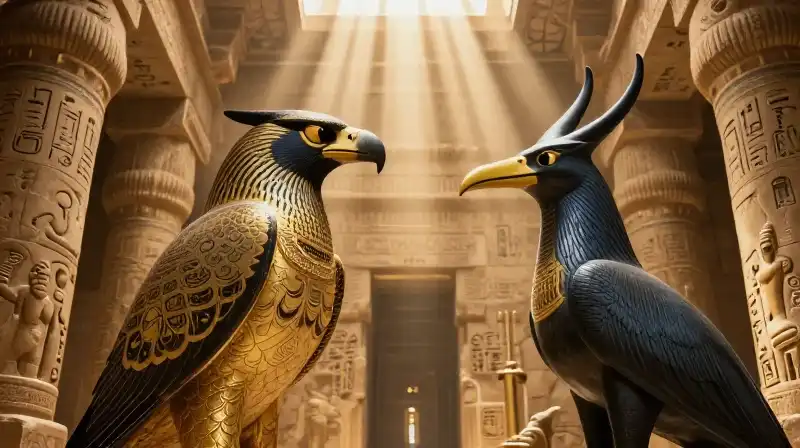
Thoth: The Ancient Egyptian God of Writing, Wisdom, and Knowledge

Introduction
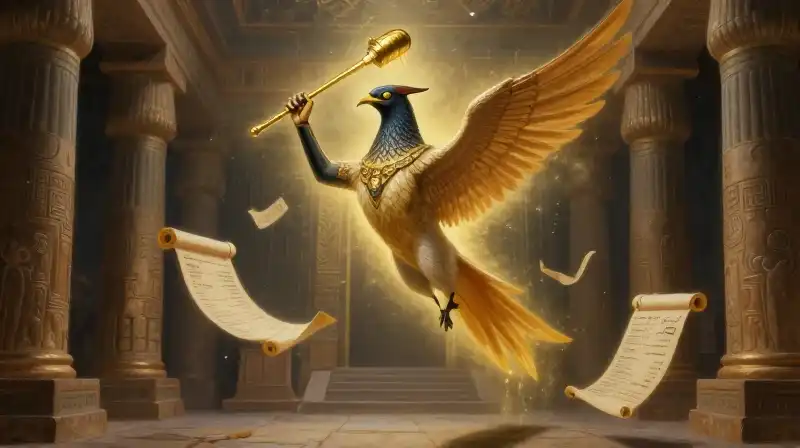
In the vast pantheon of ancient Egyptian deities, Thoth stands apart not as a thunderous warrior or a drama-centered figure like Ra or Amun, but as the embodiment of quiet, cerebral power. He is fundamentally understood as the deity of wisdom, knowledge, writing, and hieroglyphs (1, 2). For the people of ancient Egypt, Thoth represented the intellectual foundation of their civilization—the ability to create, calculate, and preserve the complex history of their world. More than just a god of record, Thoth occupied a unique position as the “scribe of the gods,” holding the vital role of mediating between opposing forces 1. He was the architect of logic, the inventor of writing and advanced sciences, and a principal participant in the great creation myths, establishing the structure of the heavens through sophisticated calculation 1. To understand Thoth is to understand the profound cultural reverence the ancient Egyptians held for the recording of knowledge itself.
The Universal Scribe: Thoth as the Keeper of Order
Thoth’s divine identity was rooted in his capacity to organize the chaos of the world into knowable, structured systems. As a god of writing, his influence was directly tied to the societal structures of Egypt. Ancient scribes held Thoth in such high regard that they often depicted him in their own offices or kept images of the deity as a testament to the intrinsic value of education and documented knowledge 1. His mastery was not limited to alphabets; he was credited with inventing various forms of essential human knowledge, including mathematics, music, and science 1. This role as an eternal teacher meant he was viewed as a conduit for intellect. In some myths, his power was vital to the restoration of divine knowledge, such as giving Isis the specific words needed to revive Osiris and enabling the conception of the next generation, Horus 1. His intellectual and mediating nature represents the “middle way”—the non-dual path of wisdom that seeks balance between extremes 1.
From Ibis to Insight: The Symbolism of Knowledge
To a reader trying to understand the Thoth god of wisdom, the physical representations are key to grasping his attributes. He was most frequently depicted in human form with the head of a green ibis, a creature that represented his precise, scholarly nature, or in his anthropomorphic and baboon forms 1. The ibis, in particular, served as a powerful symbolic metaphor for the god’s attributes. The symbolism of the ibis is further explained by his Egyptian name, *ḏḥwty*, which scholarly discussion suggests may mean “He who is like the ibis,” directly linking the animal to his divine traits 1. Furthermore, his deep association with the Moon reinforced his cyclical nature. The lunar disk was often placed on his headdress, symbolizing the cycles of renewal and the organized flow of time that governed Egyptian rituals, events, and calendars 1. The transition from the physical ibis to the concept of deep insight highlights the traditional Egyptian belief that the pursuit of wisdom was a journey that mirrored the natural, predictable cycles of the cosmos.
Guiding the Soul: Thoth in the Judgment of the Dead
One of Thoth’s most critical roles in the ancient Egyptian cultural landscape is his function in the afterlife. He acted as the ultimate “scribe of the underworld,” responsible for recording the pivotal moments of the deceased’s judgment 1. This was a moment of immense cultural significance, determining the eternal fate of a soul. During this divine trial, Thoth was the meticulous witness who verified the heart of the deceased against the feather of Ma’at—the embodiment of truth, order, and justice 1. His role was not one of judgment through wrath, but of precise, unbiased accounting. By recording whether the soul had lived a life aligned with Ma’at, Thoth provided the objective documentation necessary for the passage into the next world, underscoring the civilization’s deep cultural commitment to ethical order and accountability.
A Bridge Between Worlds: Thoth’s Cultural Legacy
While Thoth is rooted firmly in Egyptian tradition, his influence extended far beyond the Nile, demonstrating how powerful concepts of wisdom and record-keeping can transcend regional boundaries. The ancient Greeks perceived the universal attributes of Thoth’s knowledge and wisdom, often drawing parallels to their own figures. This is most visible through the Greek association of Thoth with the god Hermes, particularly through the title *trismégistos*, which translates to “Thrice great” 1. This adoption by the Greeks solidified Thoth’s reputation as a “god of wisdom” and ensured that his principles—the valuing of logic, the power of the written word, and the ability to mediate between the human and divine realms—remained a key cultural touchstone in the Mediterranean world. The enduring legacy of Thoth is the understanding that knowledge is not merely information, but a structured, recorded, and carefully maintained force. He represents the quiet dignity of the scholar, the essential nature of balance, and the fact that even the grandest mythological systems require a precise scribe to maintain their order.
References
Footnotes
Frequently Asked Questions
Who is Thoth of wisdom?
Thoth is the fundamental deity of wisdom, knowledge, writing, and hieroglyphs in ancient Egyptian culture. He is understood as the intellectual foundation of the civilization, credited as the architect of logic and the inventor of writing and advanced sciences.
Related Articles