Firebird Mythology: Global Meanings and Ancient Avian Legends

Introduction
Across various mythologies, few concepts are as potent or as elusive as the mythical bird associated with fire. While many cultures have their fiery or blazing creatures, the archetype of the Firebird—often referred to as the *zhar-ptitsa* or *Pták Ohnivák* in Slavic lore—transcends the simple definition of a creature of heat. It functions instead as a profound cultural metaphor: a powerful, prophetic, and fundamentally ambivalent force.
To study the Firebird is to understand the complex relationship between human aspiration and natural power. It is a symbol that simultaneously represents the highest potential for creation and the greatest potential for ruin. Rather than being a creature defined by its appearance, the Firebird is defined by its quest, its light, and its inherent unpredictability. To truly understand this legend, one must look beyond its golden plumage and examine how diverse communities weave this elemental power into their narratives of fate, rebirth, and spiritual balance.
The Dual Nature of the Flame: A Study in Ambition and Fate
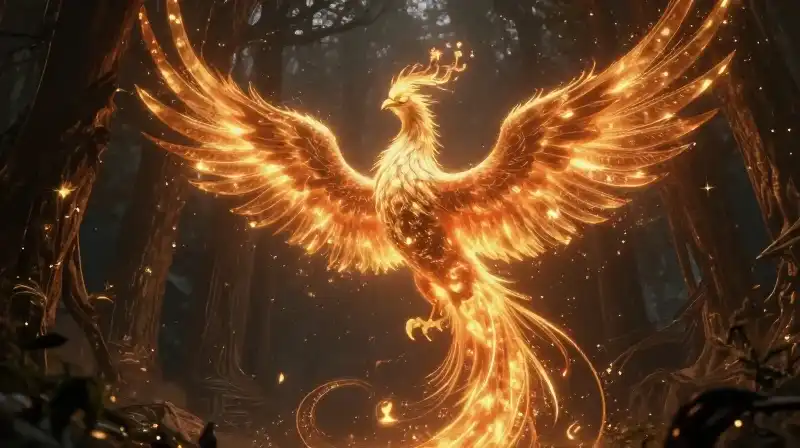
In the Slavic tradition, the Firebird is most powerfully depicted as an object of destiny rather than a literal, static entity 1. Its primary characteristic is its intense, magical luminescence, often described as a majestic golden glow that emits red, orange, and yellow light—a light so potent that a single feather is said to have the capacity to illuminate an entire room 1. However, the Firebird is defined by its dual symbolism. It is not a mere blessing; it is a double-edged symbol that can act as a harbinger of both ultimate good and inevitable destruction for those who seek to possess it 1.
This inherent danger is why the Firebird is so central to the narrative structure of the quest. Heroes often embark on arduous journeys to find or capture this magnificent being 1. Yet, the tradition constantly challenges the idea of capture. The Firebird represents a force that defies ownership. Narrative variations exist where the pursuit fails catastrophically, sometimes resulting in the Firebird being cursed into a diminished state, such as a mortal woman or an orphan 1. The legend thus serves as a warning: the most transformative powers are those that cannot be controlled, only understood.
Elemental Forces and Cosmic Order: The Global Avian Spectrum
While the Firebird is a Slavic staple, the concept of a powerful, flaming, or divinely connected avian figure is global, each version rooted in a distinct cosmological need. Across various cultures, the mythological bird acts as a regulator of the universe, a carrier of creation, or a keeper of ancient balance 1.
In East Asian mythology, this concept appears in diverse forms. The Chinese Vermillion Bird serves a vital function as the guardian of the South, contributing to an ancient cosmological balance alongside other sacred animals 1. Parallel to this is the shared concept of the Fènghuáng (Chinese) and the Huma (Indian), both of which embody powerful themes of cyclical rebirth (1, 2). The Huma bird, for instance, is uniquely tied to the cycle of death and renewal, having the ability to explode and rise phoenix-like from its own ashes at the culmination of its life (1, 2).
Further afield, elemental forces manifest in the avian figures of Finnish mythology. Creatures known as *kokko/vaakalintu* or *ukkolintu* are strongly associated with the genesis of fire and thunder, establishing a deep, primal link between elemental natural forces and powerful avian imagery 1. This connection between sky, fire, and thunder is a theme echoed, though in different ways, by the Japanese Basan, a lesser-known regional variant described as a chicken capable of breathing “ghost fire” 1.
Beyond the Fire: Regional Nuances in Avian Mythology
The flexibility of the Firebird archetype is perhaps best demonstrated by its many regional deviations. Not every “fire bird” is defined by the consumption of flame. For instance, in ancient Persian mythology, the Huma bird is depicted not through fiery breath, but through its sheer majesty; it is said to never touch the earth, and witnessing it brings a profound sense of joy, though attempting to hunt or kill it is fatal 1. This suggests that in some traditions, the power is spiritual and untouchable, rather than volatile and destructive.
Other variations reveal fascinating contrasts. The Sumerian Anzu, for example, stands as a powerful, myth-shaping deity, yet is explicitly tied to the element of water, highlighting that the function of the divine bird is entirely dependent upon the cultural needs and environmental forces of the people who created the myth 1. An even more distinct counterpoint is the Armenian Hazaran Blbul, which shares the Firebird’s theme of a monumental quest but deviates significantly: its power lies not in fire or light, but in its song, which is said to bring the land to vibrant bloom 1.
The Firebird in Modern Culture and Legacy
The enduring power of the Firebird ensures its continuation long after the tales were first told. Its compelling imagery—the confluence of beauty, danger, and ultimate power—has made it a potent subject for artistic interpretation. The most famous example of this is the incorporation of the Firebird into Sergei Diaghilev’s renowned ballet, which depicts a creature that transcends conventional definition by being half-woman and half-bird 1. This evolution shows how the myth is not static; it adapts to reflect contemporary artistic and spiritual interpretations of power.
Furthermore, the Firebird has served as a profound inspiration for literature and musical compositions, most notably Igor Stravinsky’s ballet 1. These cultural works take the core themes of the myth—ambition, destiny, and the elusive nature of true beauty—and translate them into new forms, proving that the legend continues to speak to human experience in ways that transcend geography and time.
Synthesizing the Legend: The Meaning of the Untouchable Light
The global traditions surrounding the Firebird and similar creatures offer a unified, if multifaceted, lesson: the most valuable forces in life—be they wisdom, love, power, or true transformation—are rarely those that can be caged or contained. The concept moves far beyond a simple definition of a “mythical fire bird”; it is a cautionary tale and a testament to the unpredictable nature of destiny.
Whether it is the Slavic creature of the doomed quest, the Chinese guardian of cosmic balance, or the Huma rising from the ashes, the tradition consistently reinforces the idea that ultimate power is a catalyst for profound change. For the modern reader, the Firebird stands as an enduring symbol of the pursuit of the magnificent—a powerful reminder that while we may strive to capture and control the elements of life, the most beautiful and potent parts of our heritage remain stubbornly, and magnificently, wild.
References
Footnotes
Related Articles