The Indian Creation Myth: Hindu Cosmology and the Cycles of Existence

Introduction
The study of Indian creation myths offers a profound gateway into one of the world’s most enduring philosophical traditions: the Hindu understanding of the universe. Unlike many narratives that posit a single, linear beginning to existence, Hindu cosmology is centered on an intricate and infinitely repeating cycle. For followers of this tradition, the universe is not a one-time event but a series of eternal beginnings and ends, a cosmic rhythm that governs existence itself. This perspective shifts the focus from a simple “what was first” to a complex understanding of *how* everything continues to be. This cosmology is not merely an ancient story; it is a living framework that shapes the spiritual and moral understanding of millions. It provides a comprehensive map of the macrocosm—the grand structure of the universe—and the microcosm—the individual soul’s place within that grand cycle. To truly grasp this heritage, one must look beyond a simple definition of creation and examine the deep cultural meanings behind perpetual birth, dissolution, and renewal.
The Philosophy of Infinite Cycles
At the heart of Hindu thought is a cyclical understanding of existence, which asserts that the universe has undergone—and will undergo—infinite cycles of creation and destruction (1, 2). This concept is often understood through the lens of the Multiverse or Multicycle theory, which suggests that multiple dimensions and countless iterations of the entire cosmic process exist 1. This cyclical nature means that the end of one universe is not a final death but a necessary phase of transformation, allowing for the renewal and birth of a new one. This endless ebb and flow of being and non-being forms the basis of the traditional concept of time, where history is viewed not as a straight line, but as a continuous, undulating wave of expansion and contraction.
The Mystery Before Form: Nasadiya Sukta
According to the ancient scriptures, the universe did not spring forth from an absolute void or nothingness. Rather, it emerged from a state of profound, unfathomable mystery. The Rig Veda, specifically the 10.129 verse known as the Nasadiya Sukta or Hymn of Creation, describes this pre-existence as a dark, misty state that neither had existed nor was it yet destined to exist 1. The hymn emphasizes a state “where the non-existent was not, the existent was not” 1. This suggests that before manifested reality, there was a state of potential, a pure energy of “Is-ness” and “Is-not-ness” combined. It is in this void that the universe, through a self-manifestation, began to take form. This philosophical depth is so subtle that knowledge of the Vedas and Upanishads, which articulate these concepts, often requires spiritual guidance to navigate its complexity 1.
The Manifestation of the Divine
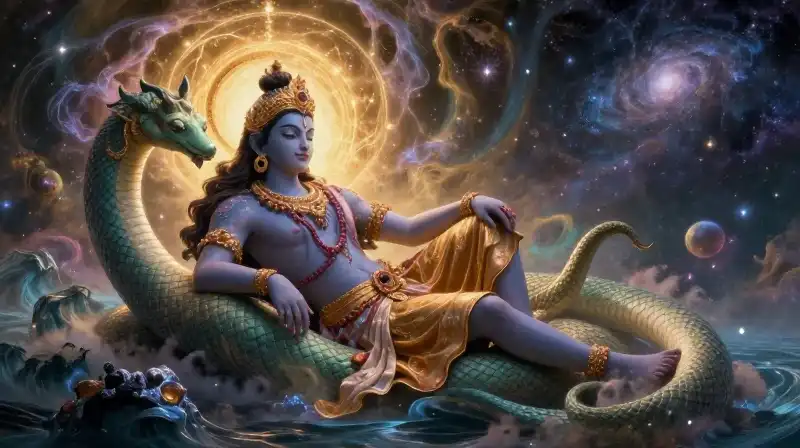
Multiple narrations across different texts describe how this initial state of mystery coalesced into the first cosmic forms. One prominent narrative involves the *Hiranyagarbha*, or the Cosmic Egg, which is believed to have been the first container for Lord Brahma, the Creator (1, 2). In another widely circulated account, Lord Vishnu, the Preserver, lies upon the vast, primordial ocean after the dissolution of a previous universe. From his navel, a divine lotus springs, and from that lotus emerges Lord Brahma 1. These myths serve to illustrate the interconnectedness of existence—creation happens within a broader, preserved cosmic order. Alternative accounts provide even more intricate origins, suggesting that Lord Brahma, driven by a sense of cosmic solitude, eventually split himself in two to manifest male and female principles, subsequently generating all living things from various parts of his body 1.
The Interconnected Roles of the Trimurti
Central to understanding the Hindu cosmology is the concept of the Supreme One—a single, overarching divinity. The figures often discussed—Lord Brahma, Lord Vishnu, and Lord Shiva—are not seen as separate gods but as interconnected forms or aspects of this single Supreme Being 1. Together, they form the *Trimurti*, and their actions drive the cosmic cycle. * **Brahma:** He is the Creator, responsible for initiating a new universe. * **Vishnu:** He is the Preserver, maintaining the order and balance of the existing cosmos. * **Shiva:** He is revered as both the Destroyer and the Re-creator. His role is crucial: he brings about the necessary end of the current universe to allow for the inevitable renewal 1. In some traditional measurements of time, Shiva’s cycle is measured through Lord Brahma’s lifespan, where every night signifies destruction and every morning signifies recreation 1.
Connecting the Cosmic Cycle to Human Life
The grand, vast cycles of the universe—the birth, preservation, and destruction of galaxies—are not merely celestial events; they are deeply intertwined with the human experience through the concepts of *dharma* and *karma* 1. *Dharma* refers to one’s duty, moral responsibility, and the inherent right way of living. When individuals live according to their *dharma*, they align themselves with the orderly, sustainable flow of the universe. Meanwhile, *karma*—the product of actions, good or bad—determines the trajectory of one’s life within the grand cycle. By understanding the macro-level cycle of creation and destruction, followers are encouraged to act with intention and purpose, recognizing that every life, like every star, is part of a vast, eternal pattern 1.
What Is the Indian Theory of Creation?
To answer this central query, the Indian (Hindu) theory of creation can be defined not by a single moment of origin, but by the doctrine of eternal continuity and cycles. It is a philosophy that posits that existence is cyclical, driven by divine principles (the Supreme One) and upheld by moral laws (*dharma* and *karma*). It emphasizes that the purpose of all living things is to find their place within the perpetual dance of creation, sustenance, and dissolution, where destruction is always a precursor to renewal 1. In essence, the theory provides a spiritual and philosophical grammar for life, suggesting that nothing is truly lost, but merely transformed into a new state within the infinite grand design of the cosmos. This deep cultural context allows for a sophisticated understanding of life’s transience while simultaneously asserting the permanence of the ultimate spiritual truths.
References
Footnotes
Frequently Asked Questions
What is the Indian theory of creation?
The Indian (Hindu) theory of creation is defined by the doctrine of eternal continuity and cycles, rather than a single moment of origin. It is a philosophy that posits existence is cyclical, driven by divine principles and upheld by moral laws, emphasizing that destruction is always a precursor to renewal.
Related Articles