Scylla, Cetus, and the Greek Sea Monsters of Mythology

Introduction
The sea, in ancient Greek culture, was the ultimate liminal space—a realm that simultaneously provided sustenance and represented the most unpredictable, profound danger. For civilizations built around maritime trade and fishing, the Aegean and Mediterranean weren’t merely bodies of water; they were vast, sentient spaces where humanity encountered the boundless forces of nature. It is within this volatile cultural landscape that the tradition of Greek sea monsters flourished. These creatures were never mere exotic beasts; they served as powerful cultural metaphors for the unpredictable, often hostile nature of the ocean itself 1. Understanding creatures like Cetus, Scylla, and the Sirens is not simply cataloging mythological figures, but recognizing how ancient peoples grappled with the anxieties, challenges, and transformative power of their environment.
The Spectrum of Duality: Beauty, Danger, and the Sirens
The Greek mythical tradition often thrived on duality—the idea that beauty and peril, help and harm, exist side-by-side. This is nowhere more evident than in the figure of the Sirens. They embodied this inherent tension. While often perceived as beautiful and enchanting, captivating figures associated with figures like Athena, the Sirens simultaneously acted as lethal lures, guaranteeing their sailors a perilous end (1, 2). This duality allowed the Greeks to explore the seductive nature of risk and the hidden costs of obsession. They represent the dangerous allure of the unknown, a temptation that could lead even the most resilient traveler astray.
Navigating the Precipice: Scylla and Charybdis
Beyond the siren’s lure, there were dangers of immediate, geometric terror. The strait of Messina, where the myth of Scylla and Charybdis emerged, presented a stark, existential dilemma for sailors (1, 2). Scylla, typically depicted as a six-headed monster, represented a singular, overwhelming predator. Charybdis, conversely, manifested as a colossal, relentless whirlpool. These two were presented as opposing forces—deadly choices where survival depended on navigating a path between two equally mortal perils (1, 2). This tradition highlights a core cultural preoccupation: the necessity of strategic choice under overwhelming threat, forcing mortals to choose between immediate, identifiable danger and inescapable, massive forces.
The Weight of Power: Cetus and the Metaphor of the Infinite Challenge
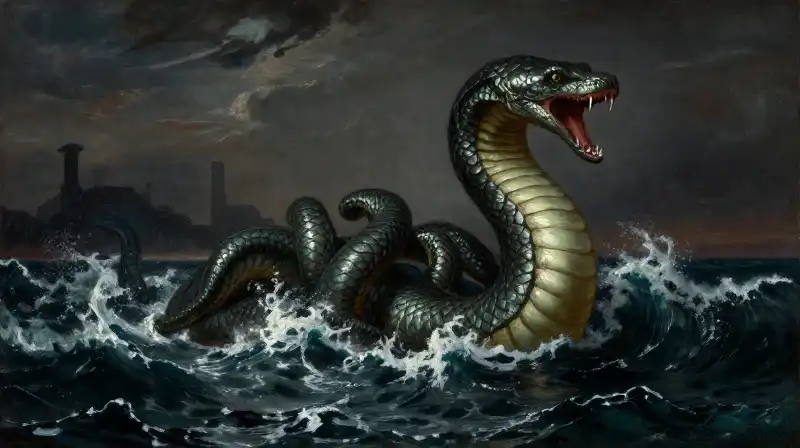
Perhaps the most powerful embodiment of raw, untamed power is Cetus. Generally depicted as a colossal sea serpent or whale, Cetus embodies immense and overwhelming strength (1, 2). Unlike the lure of the Siren, Cetus represents a titanic, existential challenge. This struggle often involved heroic intervention; Perseus or Heracles were tasked with defeating Cetus to rescue individuals who had been taken or sacrificed (1, 2, 3). The myth of Perseus and Andromeda provides a specific, culturally charged narrative. Cetus, in this tale, functions not as a random monster, but as a divine act of punishment orchestrated by Poseidon, meant to consume the princess after her mother made a boast of superior beauty (2, 3). Here, the sea monster translates a human social or moral slight into a catastrophic, divine natural consequence. Cetus, therefore, is a symbol of forces beyond human control, yet also a target that human ingenuity and divine aid (like Perseus’s) can confront. The regenerative Lernean Hydra further informs this theme of insurmountable threat. This multi-headed creature, which required constant strategic intervention to defeat, symbolizes the persistent and lethal nature of an impossible or continuously renewing problem 1. The diverse appearances of Cetus—ranging from serpentine fish to creatures with the heads of wild boar or greyhounds, sometimes even used as mounts for sea nymphs 1—reflect the mythological tradition’s fluidity and capacity to incorporate diverse animal archetypes into its massive central figure.
Cross-Cultural Echoes: The Linguistic Journey of the Kētos
The tradition of immense sea monsters extends far beyond classical Greek borders, underscoring the universal human need to mythologize oceanic terror. The linguistic lineage of *cetus* or *kētos* is historically significant, as the classical term for a huge sea monster served as the etymological root for the modern scientific word “cetacean” 1. This connection roots the most abstract myths in concrete scientific classification. Furthermore, the conceptual link between Greek and other ancient cosmologies is evident. The term *kētos* used in the Septuagint (the Greek translation of the Hebrew Bible) translates the Hebrew *tannin*. This linguistic parallel connects the mythological sea monsters of the Mediterranean to broader biblical narratives concerning primordial creation and the beasts of the world, showing how shared concepts of terrifying, foundational creatures permeated ancient global narratives 1.
The Sea as a Transformative Journey: Beyond Monsters
While creatures like Scylla and Cetus embody pure danger, the broader mythical landscape, including figures like Calypso and Circe, reframes the sea as a crucible for human experience. The numerous trials and encounters with these powerful beings—as seen in the story of Odysseus—are not merely obstacles to be cleared; they are transformative experiences 1. The sea, despite its monsters and dangers, becomes a defining character in a journey of self-discovery and endurance. These narratives thus validate the human capacity for resilience and determination in the face of unpredictable, overwhelming power, turning mortal voyages into profound tests of character.
The Enduring Cultural Meaning of Sea Monsters
Greek sea monsters remain a vital part of living culture because they act as a mirror to human existence. They are the narrative mechanism through which ancient communities processed the duality of nature—the overwhelming beauty of a calm sea countered by the swift, silent devastation of a storm. Cetus and Scylla are not simply definitions of mythological creatures; they are deeply ingrained cultural metaphors. They represent the inescapable reality that for every profound journey, whether physical or spiritual, there is a host of immense, indifferent forces waiting to test one’s will. These traditions offer a powerful lens through which to view the persistent human relationship with the vast, unpredictable ocean.
References
Footnotes
Related Articles