
Lunar New Year Food Traditions: The Symbolism of Asian Cuisine

Introduction
For communities across Asia, the Lunar New Year is far more than a simple change in date; it is a weeks-long cultural marathon centered on the reunion of family and the hopeful transition into a new cycle 1. This deeply ingrained cultural practice manifests most vividly through the preparation and consumption of food. Far from being mere sustenance, the dishes served during this time operate as edible poetry—each shape, flavor, and ingredient chosen for its specific auspicious meaning and connection to prosperity. To truly understand Asian culinary traditions during this festival, one must look past the recipe and examine the intentional symbolism, which transforms a meal into a profound wish for health, wealth, and harmony in the coming year.
The Etymology of Fortune: Homophonic Symbolism in Chinese Cuisine
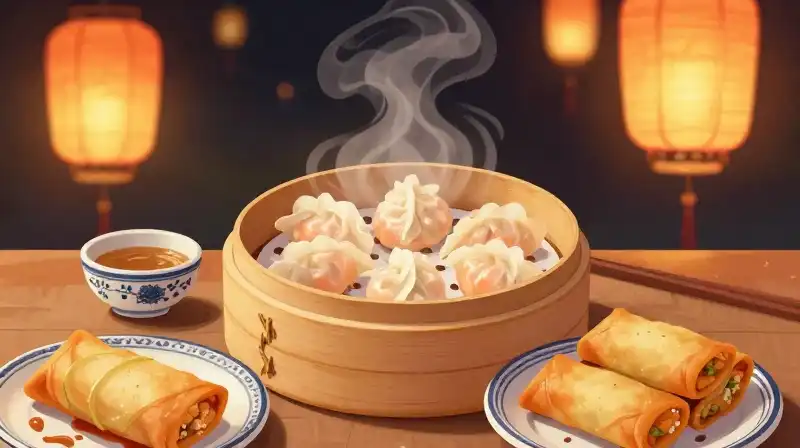
In Chinese tradition, the selection of Lunar New Year foods is often governed by a nuanced blend of phonetics and visual aesthetics, a practice known as homophonic symbolism. These choices are not arbitrary but are designed to evoke positive desires through the sounds or appearances of the ingredients. For instance, the consumption of steamed whole fish is particularly significant because the word for “fish” (鱼) phonetically resembles the word for ‘surplus’ (1, 2). This practice aims to invoke a continuous stream of abundance throughout the year. Beyond fish, specific varieties are chosen to further guide fortune: while crucian carp is celebrated for signifying ‘good luck,’ mud carp is traditionally consumed for wishing for ‘gifts’ 1. Similarly, many staple dishes are meticulously crafted to reinforce these wishes. Chinese dumplings, or *Jiǎozi*, are widely eaten on New Year’s Eve, frequently shaped to resemble silver ingots—a deliberate visual cue designed to invite wealth and financial fortune 1. The glutinous rice cake known as *Niángāo* 1 is also central to this tradition; its phonetic qualities are tied to the idea of ‘getting higher year-on-by-year,’ symbolizing continuous ascent and improvement in all aspects of life, including business and social standing.
Shapes and Sounds: Manifestations of Unity and Longevity
The concept of “wholeness” and generational connection is perhaps best understood through the shape of certain celebratory foods. *Tang Yuan*, or Chinese Glutinous Rice Balls, are highly culturally significant. Their perfectly round shape and their phonetic link to the phrase ‘group-group round-round’ encapsulate the central ideal of a happy family reunion and togetherness (1, 2). This theme of continuous, unbroken life is echoed in the culinary practice of eating longevity noodles in North China. The deliberate choice of long, unbroken noodles symbolizes the eater’s wish for an enduring, long, and uninterrupted life 1. Even seemingly simple items like spring rolls (*Chūnjuǎn*) contribute to the atmosphere of abundance; their golden-yellow color and curved appearance are frequently compared to gold bars, serving as a powerful wish for immense prosperity 1.
A Look at Regional Variations and Cultural Blending
The Lunar New Year table offers a fascinating study in regional variation and cross-cultural exchange. In North China, the emphasis on fish surplus is a well-established expectation. However, traditions are not uniform across the entire country; in some regions, customs dictate that the head and tail of the fish must be saved and not consumed until the new year officially begins 1. Vietnamese traditions, celebrated during *Tet*, offer a distinct culinary narrative. The centerpiece is often *Banh Chung*—tightly wrapped bundles of sticky rice packed with fatty pork and mung beans—which serves as the staple to celebrate the festival 1. The concept of a complete cycle is further represented by the serving of a whole chicken, which must include its head and feet to signify a complete beginning and end to the passing year 1. These regional differences highlight how diverse traditions coexist within the broader Lunar New Year observance. Furthermore, the celebration is rarely isolated to a single cultural boundary. Cultural blending is a testament to the dynamic nature of modern Asian communities. One can find classic Chinese staples coexisting on the table alongside adopted dishes like Korean *Japchae* (glass noodles) and Vietnamese *Chả Giò* (Imperial Rolls), demonstrating a rich tapestry of shared festive practices 1.
Navigating Health and Dietary Needs During the Festival
As the celebration centers on rich, flavorful, and symbolically heavy foods, dietary considerations become increasingly relevant. For those with health conditions like diabetes, the sheer sugar content often found in traditional celebratory desserts presents a challenge. Because many classic festive foods rely on glutinous rice (as seen in *Tang Yuan* and *Banh Chung*) or sweetened noodle preparations, conscious selection and moderation are essential. When seeking culturally appropriate options, individuals can look toward dishes where the symbolic meaning is based on savory whole ingredients, such as the steamed whole fish or savory pork-filled dumplings, while being mindful of the accompaniments.
A Living Tradition of Meaning
Lunar New Year food traditions are not merely historical relics; they are actively lived, evolving practices that connect the past with the hopes for the future. From the careful shaping of dumplings to the careful selection of ingredients that sound like fortune, the food becomes the physical manifestation of a collective wish for well-being and continuity. These culinary traditions demonstrate the enduring power of food to communicate identity, history, and profound cultural values, ensuring that the spirit of family reunion remains central to the celebration, regardless of modern changes.
References
Footnotes
Frequently Asked Questions
What Chinese food is good for diabetics?
For those with diabetes, the article suggests looking toward savory whole ingredients like steamed whole fish or savory pork-filled dumplings when seeking culturally appropriate options. Conscious selection and moderation are essential, as many classic festive foods rely on glutinous rice or sweetened preparations.
Related Articles