
Greek Gods: The Symbolic Meaning Behind the Pantheon

Introduction
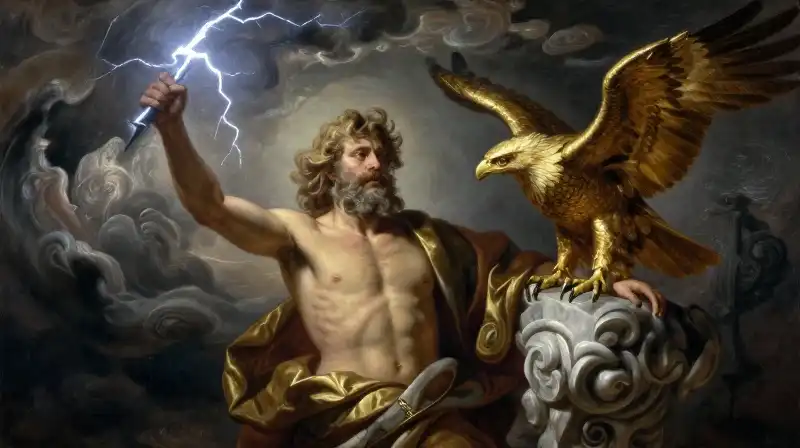
For many, the Greek gods are a familiar list of names and powers, taught as a series of fascinating myths. However, to view the pantheon merely as a collection of characters misses the profound cultural function these deities served. In ancient Greece, the gods were not just figures of legend; they were embodiments of the entire spectrum of human experience—the triumphs of reason, the fury of passion, the necessity of agricultural cycle, and the inevitability of cosmic balance. The tradition of the Greek pantheon offered a sophisticated language through which the community understood the chaotic nature of the universe, the limitations of mortal life, and the complex relationship between human desire and divine will.
From Void to Order: The Primordial Landscape
The narrative of Greek cosmology begins not with power, but with nothingness. At the absolute beginning was Chaos, personifying the boundless void and the state of absolute non-existence 1. From this original nothingness, existence began to take form. Gaia, the personification of the Earth, represented the material reality of the Universe—the solid foundation upon which everything else would grow. Chaos, in this primordial stage, symbolized the vast, limitless space itself 1. As the narrative progresses, the cosmos shifts through cycles of rule and upheaval. The early divine order was established by Titans like Cronus, who asserted dominance after overthrowing Uranus. This shift in the cosmic hierarchy represented a crucial transition in the establishment of a new ruling divine authority 1. These foundational myths established that creation was not a singular, perfect event, but a tumultuous process of constant struggle and change.
The Pantheon as a Reflection of Human Nature
The most striking aspect of the Greek pantheon is not their divine power, but their profoundly human flaws. The gods were understood by the ancient Greeks as embodiments of complex human nature—they were capable of immense grandeur but equally susceptible to passion, petty squabbles, and vindictiveness 1. This internal conflict is exemplified through archetypal contrasts. Athena, representing the noble pursuit of reason, strategic warfare, and civilization, stands in stark opposition to Ares, who embodied raw, unchecked bloodlust. Both are recognized as forces of conflict, but they represent fundamentally different *ways* of achieving victory. Similarly, the contrast between Aion, the god of pure eternity, and Chronos, the god of linear time, suggests a profound philosophical consideration of human perception versus cosmic reality 1.
Cosmic Balance and Divine Retribution
To understand the Greek concept of justice, one must look to Nemesis. This divine force embodied retribution and the crucial concept of cosmic balance. Nemesis operated conceptually similarly to the notion of karma—the idea that undeserved fortune or hubris would inevitably be counterbalanced by misfortune, ensuring a natural equilibrium in the world 1. This ensured that while the gods were powerful and often erratic, the universe remained accountable to a higher, immutable standard of balance. The forces governing physical existence were equally diverse. Poseidon’s domain extended far beyond the crashing waves of the sea; he was also linked to the unpredictable terrors of earthquakes and the mastery of horses, reflecting the varied and often dual nature of his influence 1.
Domains of Survival and Innovation
The traditions of the gods often revolved around the practical realities of community life. The role of Demeter is central to this understanding; she governed agricultural stability, making her a critical figure in the Eleusinian Mysteries. This reverence for fertility and the cyclical nature of harvest was one of the most important religious rites of ancient Greece, ensuring that the gods were intrinsically linked to the survival of the mortal community 1. Yet, the gods were not merely observers; they were active participants in the growth of mortal civilization. Prometheus, for instance, is remembered for the critical intervention of gifting fire to humankind. This action represented one of the earliest and most significant examples of the divine impacting the trajectory of human culture and development 1.
Mediators and the Flow of Influence
The connection between the divine and the mortal world was maintained through several key figures. The Oracle at Delphi, disseminated through Apollo, served as the authoritative mouthpiece for divine will, providing guidance to supplicants navigating complex human choices. While contemporary scholarly scrutiny has examined potential environmental factors affecting its pronouncements 1, its function remained paramount in the cultural exchange between the sacred and the secular. Furthermore, Hermes occupied a unique and multifaceted cultural space. He functioned not only as the swift messenger between the gods and humans but also as a figure associated with pastoral care, luck, fertility, and even cunning deception 1. This breadth illustrates how the divine was integrated into every aspect of daily life, from the harvest to a simple traveler’s journey.
Beyond the List: The Lasting Symbolic Meaning
The Greek gods provided far more than a catalog of names; they provided a map for understanding the human condition. They taught that existence was characterized by perpetual flux—from the silence of Chaos to the ordered, though often messy, hierarchy of Olympus. By depicting the deities as flawed, powerful, and driven by complex impulses, the Greeks offered a relatable framework for exploring ambition, justice, sorrow, and the necessity of balance 1. The enduring power of this tradition lies in this narrative capacity: it allows the reader to see the cosmos not as a collection of random facts, but as a richly textured drama where human struggles and divine mandates constantly intersect.
References
Footnotes
Frequently Asked Questions
What are the 12 main Greek gods?
The article does not specify a definitive list of 12 main Greek gods. It instead identifies various influential deities, such as Athena, Ares, Poseidon, Demeter, and Hermes, to illustrate different aspects of human nature and cosmic balance.
Related Articles