Pegasus: The Mythical Winged Horse of Greek Legend and Symbolism

Introduction
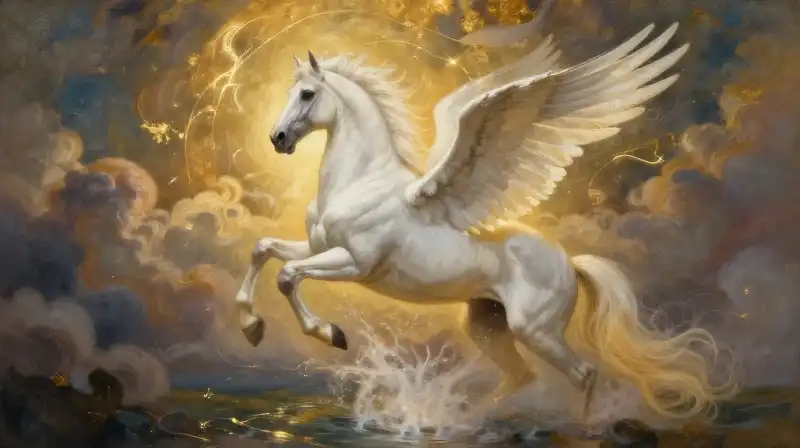
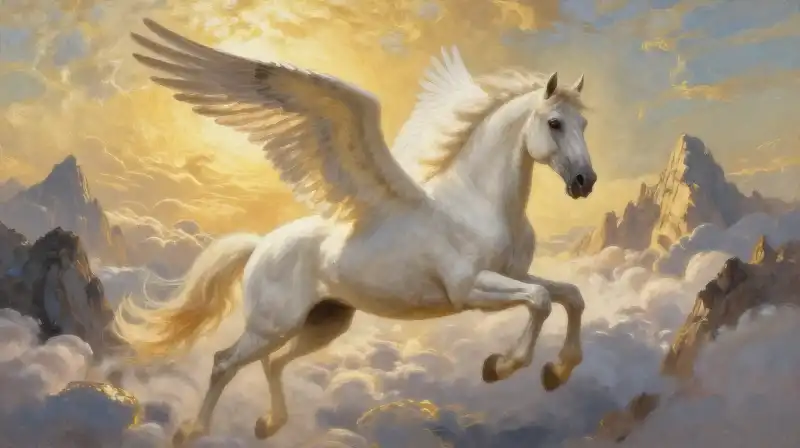
In the tapestry of Greek folklore, Pegasus occupies a unique space—not merely as a beautiful creature, but as a potent conduit between the mortal realm and the divine. Often depicted as a brilliant white stallion with magnificent wings, Pegasus is far more than a spectacular beast. He is a profound symbol of inspiration, swift ascent, and divine power. His existence was woven into the very fabric of the Greek cosmos, linking the gods, the act of creation, and the pursuit of higher knowledge.
To understand Pegasus is to engage with a rich cultural tradition. While he originates in the dramatic narratives of ancient Greek mythology, his image has transcended the ancient world to become a significant motif in civic heraldry, institutional crest-work, and even modern history. He represents a journey—the potential for the mortal spirit to touch the sublime. This article explores the foundational myths of the winged horse, examining how his divine lineage informed his role as a powerful cultural signifier.
Birth and Divine Lineage
The legend of Pegasus begins with a moment of immense mythological drama. Pegasus was born following the beheading of Medusa by the hero Perseus (1, 2). Unlike other creatures born of conflict, his emergence was intrinsically tied to the divine order of Olympus.
His lineage is not accidental, but deliberately connected to powerful forces. His existence is traced back to Poseidon, the god of horses, who granted him a powerful identity rooted in Olympian authority (1, 2). By linking the creature to Poseidon, the myth connects Pegasus immediately to the power of the sea and the untamed energy of equine life. This divine parentage ensured that Pegasus was destined for a role that extended far beyond that of a simple companion, placing him among the extraordinary beings of the Greek pantheon.
The Symbolism of Inspiration and Creation
Pegasus’s most enduring cultural significance lies in his association with creative power and the act of inspiration. He is intrinsically tied to water, specifically through his supposed role in the creation of spring waters across the earth. Among these, Hippocrene on Mount Helicon is the most celebrated (1, 2).
According to the tradition, the waters from Hippocrene possessed the magical property of inspiring the Muses and various writers. This association elevated Pegasus from a mere horse to a symbol of poetic genius and intellectual fertility. He represents the spark that allows humans to transcend the mundane and tap into higher realms of thought and art.
Furthermore, the creature embodies raw, celestial power. Ancient narratives link Pegasus to lightning and thunder. One etymological theory for his name suggests a derivation from the Luwian term pihassas, which relates to thunder and lightning 1. This connection is formalized in his later role; Zeus task Pegasus with carrying his thunderbolts, firmly establishing the winged horse as a symbol of divine power and stormy, overwhelming energy (1, 2). In this capacity, he is not only a source of gentle inspiration but also a manifestation of immense, unstoppable forces.
Debating the Myth: Individual or Species
One of the most fascinating aspects of the Pegasus tradition is the scholarly debate regarding his nature. Is Pegasus a representative species, or is he intended to be a singular, unique individual?
In modern discourse, this question is often raised to clarify the scope of the mythology. Some commentators suggest that within the specific context of Greek mythology, Pegasus should be viewed as a unique entity rather than an archetypal representation of a definable species 1. However, his powerful symbolism—as the bringer of inspiration and divine messenger—is so strong that he functions, in cultural practice, as a symbol representing the potential for divine connection, regardless of whether he is a singular or universal archetype.
Furthermore, the origin of his name remains debated. While the proposed etymology *pegai* (meaning ‘spring’) references his alleged birthplace near the springs of Oceanus (1, 2), the alternative theories continually remind scholars that mythological nomenclature is complex and often layered with linguistic echoes from other cultures.
The Evolution of Pegasus in Human Culture
Long after his initial appearance in Greek myth, Pegasus demonstrated a remarkable ability to transition into the iconography of human culture, evolving from a literary figure to a practical emblem.
In ancient civilization, his presence was found in regional traditions, notably appearing on early Corinthian coinage, where the winged horse served as a civic symbol 1. This early use demonstrates how the myth was swiftly absorbed into the identity of specific communities.
This cultural appropriation continued through the eras of European heraldry. The “pegasus rampant”—the depiction of the winged horse in an alert, rearing position—became a standard crest and supporter used on the arms of various families and important institutions, such as the Inner Temple 1. He was then re-imagined in the modern era when Bellerophon, often depicted riding the winged horse, was adopted as the insignia for the United Kingdom’s WWII parachute troops 1. Each adoption in human history reaffirms the tradition’s core message: the combination of mortal skill (Bellerophon/the soldier) and divine aid (Pegasus/the symbol of flight and power).
Synthesis: The Ascent of the Spirit
Pegasus serves as a powerful cultural mirror, reflecting humanity’s yearning for transcendence. His narrative—often linked to the mortal Bellerophon’s flight towards Olympus 1—is fundamentally a story of ascent. He is the mechanism by which the mortal spirit interacts with the divine realm.
For the contemporary reader, Pegasus offers more than a beautiful image. He represents the potential for creation (the spring waters), the embodiment of raw power (Zeus’s thunderbolts), and the aspirational leap toward greatness. Whether depicted on an ancient coin, a family crest, or in the pages of a modern myth, the winged horse stands as an enduring symbol of the bridge between the earthly and the ethereal.
References
Footnotes
Frequently Asked Questions
What kind of mythical creature is Pegasus?
Pegasus is a mythical winged horse often depicted as a brilliant white stallion with magnificent wings. He is also described as a symbol of divine power, as ancient narratives link the creature to lightning and thunder.
Related Articles