Pegasus Backstory: How the Winged Horse Came to Be

Introduction
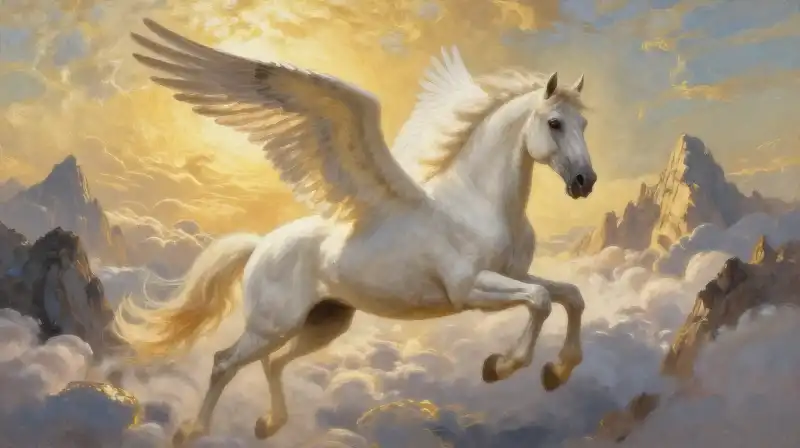
The tale of Pegasus is one of the most powerful and enduring narratives in the Western cultural tapestry. For those seeking the backstory of this winged stallion, the answer lies in the volatile intersection of divine power and mortal heroism in Greek mythology. Pegasus was not merely a beautiful creature; he was a manifestation of divine energy—a powerful symbol of inspiration, speed, and untamed potential. His origins are rooted in the myth of Medusa and the sea god Poseidon, placing him at the epicenter of a dramatic cosmic clash. More than just a mythological figure, Pegasus represents the journey from primordial chaos to soaring artistic potential.
Understanding his story requires looking past the simple image of a flying horse and into the rich layers of Greek belief. He is a creature of elemental power, linked directly to the sacred springs of Mount Helicon, and a subject of enduring scholarly debate regarding his true name and ultimate purpose. This is not simply a legend; it is a living cultural text that speaks to the power of art, the limits of mortal aspiration, and the enduring strength of divine connection.
The Genesis of a Myth: Medusa and Poseidon’s Kinship
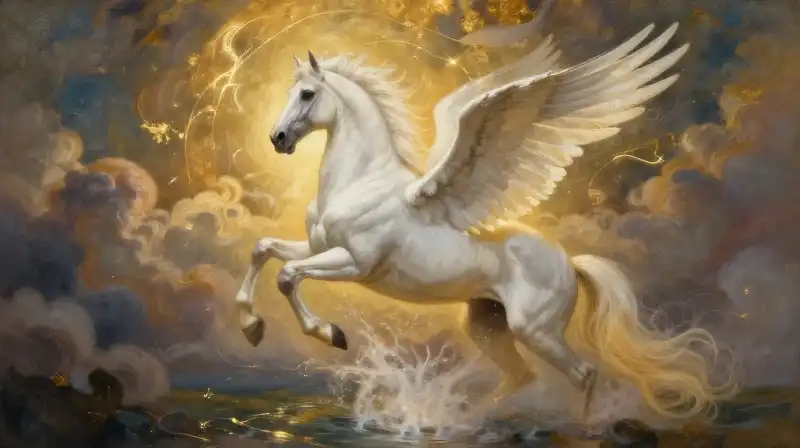
The fundamental narrative of Pegasus’s creation involves the most terrifying figures of ancient myth: Medusa, the Gorgon, and Poseidon, the mighty god of the sea. According to core tradition, Pegasus was sired by Poseidon in his capacity as the horse-god, and he emerged from the decapitation of Medusa at the hands of the hero Perseus (1, 2). This powerful linkage suggests an origin tied to the wild, primal forces of nature.
However, the origins of the winged mount are subject to scholarly interpretation and variation. While some accounts position his birth at the mythical “spring of Oceanus” 1, other narratives suggest a more visceral origin—that Pegasus was formed from a mingling of Medusa’s blood and sea foam, reinforcing his deep connection to the chaotic waters of the ocean 1. Whether his birth was purely divine or tragically accidental, the result was a creature of immense, untamed power.
There is even a subtle linguistic debate surrounding his name. Some scholars propose that the name Pegasus derives not simply from the Greek word for spring (*pegae*), based on his ability to create water streams by striking the earth, but potentially from a Luwian interpretation of the word for lightning, aligning with his later portrayal as a bearer of Zeus’s thunderbolt 1.
The Wings of Inspiration: Pegasus and the Muses
The most significant cultural function of Pegasus in the Greek tradition is his association with divine inspiration and the arts. Pegasus is intrinsically linked to Hippocrene, the sacred “Horse Spring” on Mount Helicon. This domain was the cherished and sacred realm of the Muses, the goddesses of the arts and sciences (1, 2). This connection transformed the once terrifying, wild creature into a symbol of creative potential.
In this capacity, Pegasus became a metaphor for the sudden, breathtaking arrival of inspiration. The winged stallion could carry the poet, the painter, and the philosopher to a heightened state of grace. The imagery shifted from the violence of his birth to the sublime act of creation. This is why his presence is so frequently found in art—he is not just a powerful beast, but a catalyst for enlightenment and beauty. His mythological capacity to create water sources solidified his symbolic role as a life-giver through divine gifts of knowledge and creativity.
The Test of the Hero: Bellerophon and the Taming of the Wild
The most famous chapter in Pegasus’s narrative involves Bellerophon, the heroic rider who proved that even the wildest divine forces could be channeled through mortal courage and divine favor. Pegasus was notoriously untamable, embodying pure, chaotic power. Bellerophon’s ability to secure the winged mount was not merely a display of bravery, but a testament to the intervention of higher powers. The goddess Athena gifted Bellerophon a golden bridle, allowing him to gain control over the magnificent creature (1, 2, 3).
This partnership—Bellerophon and Pegasus—is central to the narrative of the heroic journey. Together, they performed deeds that defied the established order, most notably the successful defeat of the monstrous Chimera (2, 3). This sequence of events tells a vital cultural story: that true heroism is not about brute force, but about the ability to responsibly manage, guide, and collaborate with great powers—be they divine, elemental, or monstrous.
The Price of Ascent: Warning Against Hubris
While the Pegasus-Bellerophon story is one of glorious victory, the tradition also carries a profound and sobering undertone: the warning against hubris. The partnership’s ultimate trajectory leads to a tragic endpoint, serving as a powerful reminder of humanity’s limits when approaching the divine.
Bellerophon and Pegasus eventually sought the ultimate validation by attempting to reach Olympus, the dwelling of the gods (1, 2, 3). This ascent was viewed by Zeus as an unwarranted transgression—a mortal attempting to appropriate divine space. The consequences were swift and harsh. Historical accounts regarding the specific cause of Bellerophon’s demise vary, with some narratives suggesting he fell from Pegasus during his attempt to reach the celestial heights, while others attribute his fate entirely to the wrath of Zeus (1, 2).
The tradition thus operates on a duality: Pegasus represents the exhilarating flight toward inspiration, but his story also warns that seeking divinity or surpassing one’s destined boundaries will invariably lead to punishment, grounding the myth in a deep philosophical caution about human pride.
From Iconography to Constellation: Pegasus in Living Culture
The enduring significance of Pegasus lies in his remarkable cultural adaptability. He has transcended his role as a mere mythological character to become a powerful, recurring symbol across millennia and geographies. His form has been adapted across diverse artistic media, from ancient Greek pottery and classical sculpture to Renaissance paintings 1. In modern contexts, his image remains vibrant, appearing in contemporary British heraldry, symbolizing courage and noble ambition (1, 2).
Perhaps the most permanent transformation of the myth is Pegasus’s shift into the celestial sphere. After Bellerophon’s tragic passing, Zeus is said to have stabled the magnificent horse in the heavens (1, 2). His presence as a constellation ensures that the tradition of inspiration and heroic power continues to guide the culture, visible across the night sky. This cosmic transition ensures that Pegasus is not confined to the past but remains a perpetually observed and contemplated force.
The Meaning of the Winged Stallion: A Cultural Synthesis
The narrative of Pegasus provides more than just a fanciful backstory; it offers a complete cultural framework for understanding power, inspiration, and fate. The story tracks a journey from violent, primal creation (Medusa and Poseidon) to profound creative mastery (the Muses) and finally to a celestial, symbolic permanence (the constellation). This progression demonstrates how a terrifying mythological figure can be transformed into a widely embraced cultural ideal.
For the reader who seeks to genuinely understand this tradition, Pegasus serves as a powerful reminder that in Greek belief, even the most wild and chaotic forces can be guided to serve higher purpose, but this mastery always comes with a critical boundary. The myth teaches that while divine gifts can grant extraordinary power and inspiration, the ultimate limits of human ambition must be respected. Pegasus remains a testament to the enduring power of art and the dangerous, beautiful yearning to transcend one’s mortal limits.
References
Footnotes
Frequently Asked Questions
What is Pegasus's backstory?
According to core tradition, Pegasus was sired by the sea god Poseidon and emerged from the decapitation of Medusa at the hands of the hero Perseus. Alternative accounts suggest he was also formed from a mingling of Medusas blood and sea foam.
Related Articles