Nefertem: The Egyptian God of the Sun, Lotus, and Rebirth

Introduction
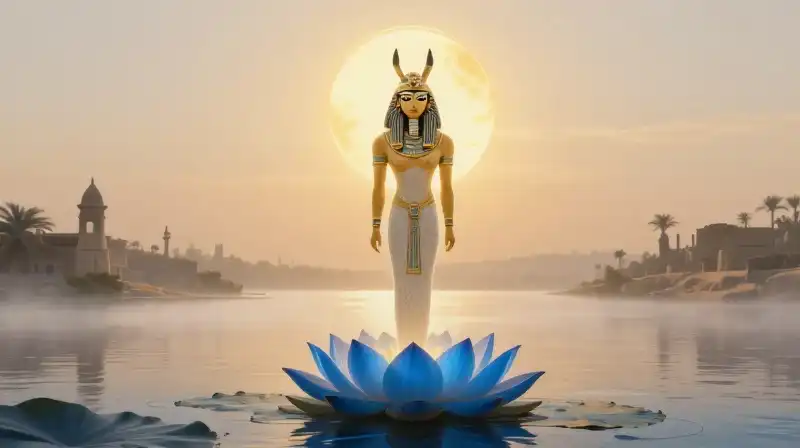
In the rich landscape of ancient Egyptian belief, where the cosmos was continually reborn with the rising sun, Nefertem (also known as Nefertum or Nefer-temu) served as a profound symbol of eternal beauty, fragrance, and the cycles of rebirth. More than merely a deity, Nefertem was deeply intertwined with the natural world, embodying the blue water-lily—the *Nymphaea caerulea*—and the evocative scent of the lotus. To understand Nefertem is to explore a connection between the sublime act of creation and the daily renewal of life, capturing the essence of the “beautiful one who does not close” 1. His mythology, his function in daily life, and his powerful symbolism illustrate how Egyptian culture sought to harmonize the chaos of the primal waters with the ordered splendor of a new day.
The Symbolism of the Blooming Sun
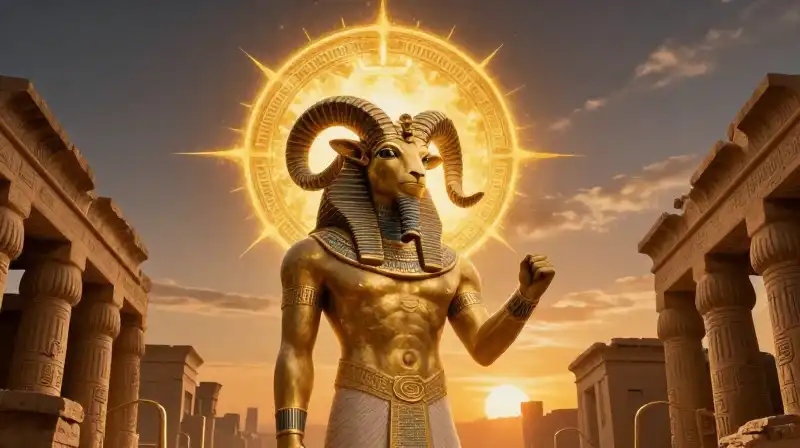
Nefertem’s fundamental identity is rooted in the emergence of light and order from primordial darkness. According to key narrative traditions, Nefertum arose from the waters of Nun at the very beginning of creation, representing the first ray of sunlight and the rebirth of the universe (1, 2). This association positions him as a central figure in the Egyptian conception of cosmic cycles; he personified the newborn sun and the daily struggle to maintain Ma’at (Order) against Chaos 1. His name itself, rendered as the “beautiful one who does not close,” suggests an unending, eternal nature—a sun that perpetually rises and a lotus that perpetually blooms. His connection to the water-lily was both aesthetic and cosmological. The blue water-lily and the intense aroma of the lotus were not merely decorative; they represented beauty, fragrance, and aromatherapy within Egyptian spiritual practice (1, 2). In the context of the funerary rites, this symbolism becomes vital: the Book of the Dead instructs the deceased to “Rise like Nefertem from the lotus, to the nostrils of Ra, and come forth upon the horizon each day” (1, 2). This command encapsulates Nefertem’s function as a guide through the cyclical journey of death and resurrection, promising the afterlife as a renewed dawn.
Patron of Beauty and Healing Arts
Culturally, Nefertem’s influence extended beyond grand cosmic narratives into the personal, tangible realm of ancient Egyptian life. He was widely regarded as a patron of both the cosmetic and healing arts (1, 2). This patronage drew deep spiritual and practical importance from the inherent medicinal properties of lotuses and other fragrant flowers. For the ancient Egyptians, Nefertem wasn’t only a figure of grand myth, but one of personal utility. The tradition of carrying small statuettes of the god as good-luck charms or protective amulets speaks to his perceived ability to bring both aesthetic grace and spiritual defense into daily life (1, 2). This aspect of his worship underscores a core tenet of Egyptian belief: that the divine presence could be harnessed to manage the complexities of mortal life—from ensuring a radiant complexion to warding off ill fortune.
The Dual Nature: Cosmos and Contradiction
A nuanced understanding of Nefertem requires acknowledging his complex and sometimes contradictory nature. He is revered as the benign personification of the rising sun and the comfort provided to the divine. 2 notes that Nefertem is understood to have offered a symbolic bouquet of lotuses to the aging god Ra, a gesture that helped ease Ra’s sufferings and cemented Nefertem’s role as a comforting agent within the pantheon. His depiction as a beautiful baby sitting on a lotus bud perfectly highlights this function: the personification of the eternal, continuous cycle of rebirth 1. However, scholarly analysis also reveals a more complex, potentially fearsome aspect. Some artistic depictions show a variation of Nefertum as a lion-headed man or a reclining lion/cat, linking him to the potent lion god Maahes (1, 2). This leonine aspect is significant because, as 2 explains, his fearsome side sometimes necessitated “divine decrees” to protect newly born children during specific periods, such as the Third Intermediate Period. This duality—the radiant, fragrant sun combined with the fierce, protective leonine power—reflect the holistic view of the Egyptian cosmos, where immense creation and powerful protection coexist.
Exploring Related Divine Connections
The lineage and precise roles of Nefertem sometimes prompt questions regarding his connections to other powerful figures. While he is widely recognized as the son of the creator god Ptah, ancient sources also present scholarly uncertainty regarding his true lineage, with some versions identifying his origins as an aspect of the god Atum (1, 2). Regarding other deities, while the question of Sekhmet is sometimes raised in relation to Nefertum, the specific cultural evidence highlights his primary association with Ptah and the cosmic cycles of the rising sun 1. Furthermore, Nefertem’s cultural importance—especially concerning his association with beauty and the celestial cycles—stands apart from the specific cult of Nefertiti, whose worship was distinct and often tied to royal and funerary practices 1.
Synthesis: The Enduring Echo of Nefertem
Nefertem remains a powerful symbol of hope and continuity. He bridges the gap between the ephemeral beauty of the blooming lotus and the relentless, life-giving power of the sun. By embodying the fragrance of creation and the promise of renewal, he provides a cultural framework for navigating cycles—be they the daily cycle of light, the human cycle of birth and death, or the natural cycle of seasons. The tradition of Nefertem encourages a contemplation of the perpetual “rising”—a constant return to the light and the order of Ma’at, regardless of the transient chaos of the moment. He stands as a beautiful reminder that from the deepest waters of the past, continuous, glorious life can always emerge.
References
Footnotes
Frequently Asked Questions
Is Nefertem the son of Sekhmet?
While the question of Sekhmet being related to Nefertem is sometimes raised, the article emphasizes that cultural evidence highlights his primary association with the creator god Ptah.
Which god did Nefertiti worship?
The article does not state which god Nefertiti worshipped, noting only that her cult was distinct from Nefertems associations.
Related Articles