Minotaur: Understanding the Myth, Origin, and the Labyrinth of Crete

Introduction
The tale of the Minotaur, a creature of formidable myth and terrifying grandeur, is far more than a simple monster story from ancient Greece. It is a cultural artifact—a complex narrative that reflects the intricate relationship between powerful communities, the tension between human and divine will, and the ingenuity of the architectural mind. This tradition, deeply rooted in the heritage of Crete and the narratives of Athenian myth, offers a window into how ancient societies processed themes of chaos, power, and divine retribution. At its core, the Minotaur represents a foundational myth from classical Greek folklore, a story that has been relentlessly reworked and retold across countless eras (Source 3).
The Genesis of a Myth: Divine Retribution in Crete
The origins of the Minotaur are intrinsically tied to the power and eventual downfall of King Minos, the sovereign of Crete. According to the narrative, the creature was born from an unnatural coupling—an event precipitated by the Olympian gods. Minos had chosen to keep a beautiful snow-white bull gifted by Poseidon, a decision that displeased the god. As punishment, Poseidon caused Minos’s wife, Pasiphaë, to mate with the bull (Source 1, Source 2). This horrific union gave birth to the Minotaur, an entity defined by its composite form: the head and tail of a bull merged onto a human body (Source 1, Source 2). This monstrous biological offspring was a potent symbol of unchecked passion and divine anger. The Minotaur’s existence was a central component of King Minos’s rule, ultimately serving as a focus of fear and political power.
The Labyrinth: Architecture as Cultural Constraint
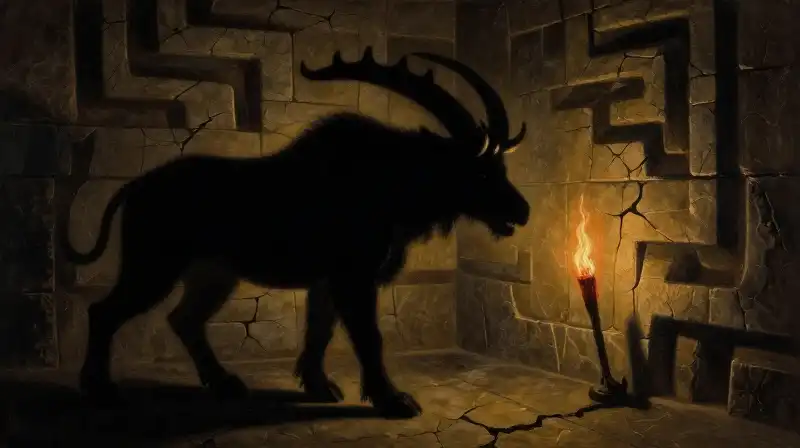
The Minotaur was not allowed to roam freely; instead, it was confined to an immense, intricate structure known as the Labyrinth, built within the city of Knossos on the island of Crete (Source 1). This structure, commissioned by Minos and designed by the legendary architect Daedalus, served dual functions: it was a sophisticated prison for the Minotaur and a profound plot device within the myth. The Labyrinth’s complexity has historical echoes in archaeology. Excavations conducted by Sir Arthur Evans around 1900 CE revealed the winding, convoluted structure of the Knossos palace complex, mirroring the complexity described in the myths (Source 2). Historically, the Labyrinth’s design suggests a profound mastery of space and structure. While the structure of Knossos is central, subsequent narrative accounts have shown shifts in its location, moving the mythical setting from Knossos to the nearby city of Gortyn due to administrative changes in Roman provincial rule (Source 3). Furthermore, the very symbolism of the bull, which frequently represented sacred power and masculine virility in Minoan culture, lends a foundational significance to the Labyrinth as a setting for this powerful symbol (Source 2).
A Symbol of Conflict: Minos, Crete, and Athens
While the narrative is set in Crete, scholars suggest that the Minotaur myth also functioned as a narrative tool for Athenians. The myth, particularly the Athenian version, involves the ritual sacrifice of young citizens, which served as a penalty following the death of Minos’s son, Androgeus (Source 1, Source 2). By placing the Minotaur in the heart of the Athenian retelling, cultural interpretations suggest the myth may have served as a mechanism for Athenians to process or critically define the powerful and potentially chaotic Minoans of Crete (Source 2). The creature, therefore, is not merely a beast but a powerful symbol of external force, unrest, or the chaotic elements of a rival culture.
Navigating the Maze: The Narrative of Theseus
The most famous version of the myth involves the arrival of Theseus, the Athenian hero, who ventures into the Labyrinth to slay the creature. In this popular account, Theseus manages to escape the maze’s complexities with the critical assistance of Princess Ariadne, who provides him with a thread to trace his path (Source 1, Source 3). It is important to recognize that this is the most commonly accepted version, but the tradition is far from monolithic. Mythological scholars point out that the Minotaur has a multitude of contradictory versions across different tellings (Source 1, Source 3). Furthermore, the creature itself has been rendered in various ways throughout classical art. Beyond the standard depiction of a man with a bull’s head, later artists, influenced by works such as those by Ovid, sometimes portrayed the Minotaur as a man’s head upon a bull’s body (Source 1).
Addressing the Question: Who Kills the Minotaur?
A frequent inquiry into this legend focuses on the slayer of the monstrous being. According to the most widespread traditional account, the Minotaur was ultimately killed by Theseus (Source 1). However, as noted, the tradition is rich with variants. Some tellings emphasize the combined efforts of Theseus and the strategic aid of Princess Ariadne, while others prioritize the beast’s tragic origins or its symbolic representation of the conflict itself, shifting the narrative focus away from a simple heroic defeat (Source 1, Source 2).
Cultural Endurance: Beyond the Definition
The Minotaur’s legacy extends well beyond a singular definition found in a textbook. The name itself, a translation of the Ancient Greek compound *Mīnōs* (Minos) and *tauros* (bull), literally means the ‘Bull of Minos’ (Source 1). Yet, its enduring power lies in its function within the cultural landscape. Even outside the strict mythological realm, the labyrinthine pattern of Knossos has been recognized as a symbol of intricate design, featured on historical artifacts like the city’s coins, some of which may have incorporated the creature or the maze itself (Source 3). The Minotaur myth remains a dynamic piece of human heritage. It teaches a lesson in the dangers of unchecked power, the necessity of navigating complex systems (the Labyrinth), and the inherent tension that exists between divine destiny and human ambition. Understanding the Minotaur is not just about knowing a monster’s characteristics; it is about appreciating the deep cultural currents that have shaped the stories of the ancient Mediterranean.
Frequently Asked Questions
What Greek mythology killed a Minotaur?
According to the most widespread traditional account, the Minotaur was ultimately killed by Theseus, the Athenian hero. Other tellings suggest the defeat was the result of the combined efforts of Theseus and the strategic aid of Princess Ariadne.
Who kills the Minotaur in mythology?
According to the most widespread traditional account, the Athenian hero Theseus slays the Minotaur after venturing into the Labyrinth. While other mythological versions exist, This account is the most commonly accepted.
How to Navigate the Labyrinth and Slay the Minotaur
Enter the Labyrinth
As Theseus, venture into the complexities of the Labyrinth in order to find the Minotaur.
Obtain Navigational Aid
Receive critical assistance from Princess Ariadne, specifically obtaining a thread to trace your path.
Trace the Path
Use the thread provided by Ariadne to carefully trace your way through the maze's winding complexities.
Confront the Minotaur
Locate and engage in combat with the creature, the Minotaur.
Achieve Escape
Manage to slay the Minotaur and successfully escape the maze’s complexities.
Related Articles