Unravel the Pixie: Origins, Appearance, and Regional Lore

Introduction
The story of the pixie is not merely a tale from a forgotten mythology; it is a cultural marker deeply rooted in the soil and landscape of southwestern England. Specifically, the folklore thriving in regions like Cornwall and Devon speaks to a centuries-old tradition of communal storytelling. For the communities of this region, pixies are more than mythical creatures—they are the embodiment of ancient heritage, tying the natural world to deep, often inscrutable, historical currents. As a “living culture,” the tradition of the pixie serves as a narrative lens through which generations have viewed the mysteries of the moor and the magic of the stones.
The Landscape of Mischief
Traditional lore establishes pixies as entities intrinsically linked to specific, venerable sites. They are often depicted as childlike beings who delight in activities like dancing and wrestling within the boundaries of ancient settlements, such as stone circles, dolmens, or barrows 1. While their actions frequently involve mischief, their nature is generally described as benevolent or “benign” rather than purely malevolent. They are deeply attuned to the environment, often playing in water or being associated with the natural music of crickets and frogs 1.
However, their affinity for guiding and misguiding travelers gives rise to specific vernacular. The term “pixie-led” describes a person who finds themselves lost within an area they are otherwise familiar with—a testament to the idea that these spirits possess a subtle, almost benevolent, power over human direction 1. This propensity for misdirection, however, is not uniform across the entire English folklore spectrum; regional distinctions clarify that while “pixies” are the common designation in Cornwall and Devon, related beings in West Penwith, known as spriggans, are specifically defined by their malevolent tendencies 1.
Varied Visages and Manifestation
Perhaps one of the most enduring and nuanced aspects of the tradition is the sheer variety of how pixies are described and encountered. Early scholarly and personal accounts describe a broad spectrum of appearances, ranging from traditional imagery—such as their common depiction in rags—to modern conventions that involve green attire and pointed hats (1, 2). This spectrum suggests that the pixie image is less a fixed definition and more a canvas for local imagination.
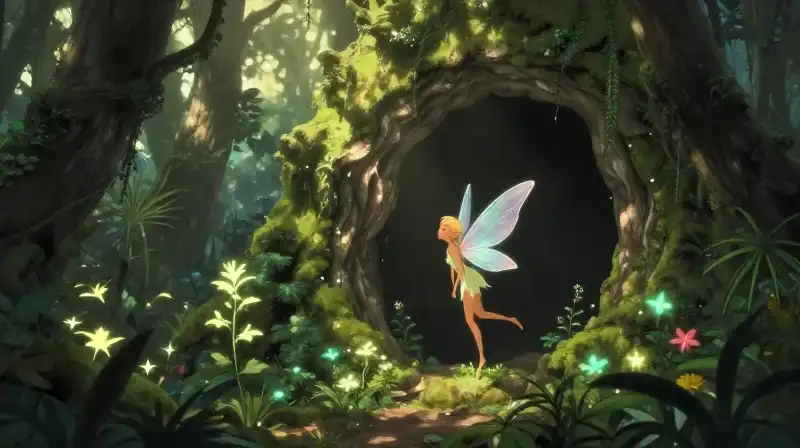
Further accounts offer a more fluid understanding of their existence. Certain personal narratives suggest that pixies are not strictly bound to one form; they can manifest as tiny creatures, as beautiful humans, or even as natural elements like dragonflies 1. This ability to change their guise supports the idea that whether a pixie is helpful or harmful depends less on an inherent quality and more on their choice to reveal themselves to humans 1.
The Human and the Hex: Pixies as Cultural Mirrors
The concept of the pixie, much like its counterparts in British folklore, often serves as a cultural mirror for human fears and virtues. In the legends of Dartmoor, for instance, pixies are recounted as disguising themselves as bundles of rags specifically to attract or lead children 1. Yet, the lore is not limited to this mischievous side; there are also accounts that highlight their helpful nature, with stories describing them as aiding needy widows 1. This juxtaposition—the capable aid versus the subtle trap—underscores the complexity of the spirit in the eyes of the local community.
Historically, this complexity has been theorized by scholars. Historical theory suggests that pixies may be ancient Celtic forebears, potentially related to Romano-British Hooded Spirits. During the Christian era, however, there were also views that the spirits represented those of unbaptized children, demonstrating how evolving religious and social contexts reshaped the tradition over time 1.
Living Lore: Pixie Day and the Modern Tradition
The survival of pixie folklore is not merely a relic of the past but a living tradition actively maintained in the present day. One notable example of this is the annual observance of Pixie Day in Ottery St. Mary 1. This observance is a localized tradition that celebrates a specific community legend concerning the perceived banishment of pixies from the town. Such celebrations and local observances are vital to keeping the stories alive, allowing the tradition to evolve as it is retold and reinterpreted by modern residents.
Furthermore, the etymology of the term “pixie” itself remains elusive, contributing to the living nature of the tradition. While some theories connect the word to modern Swedish dialects, others maintain a stronger root in Proto-Brythonic Celtic, reflecting the deep historical grounding of the concept within the region 1. The enduring uncertainty surrounding its origin allows the folklore to continue to feel fresh and relevant to modern audiences seeking connection to a past they can almost touch.
Synthesizing the Myth: What Pixies Mean to the Community
To truly understand the pixie is to understand the culture of Southwestern England. They represent the point where nature and human history intersect—where ancient British stones meet the everyday lives of local families. While the traditions describe a spectrum of pixies—some mischievous, some helpful, some purely elemental—the core meaning they hold is one of interconnectedness. They remind the community of a profound history, a belief in the magic that persists beneath the everyday landscape, and the richness of a narrative tradition that prioritizes nuance over simple definition.
References
Footnotes
Related Articles