Onikuma to Stiff Leg: Powerful Mythical Bears in Global Lore

Introduction
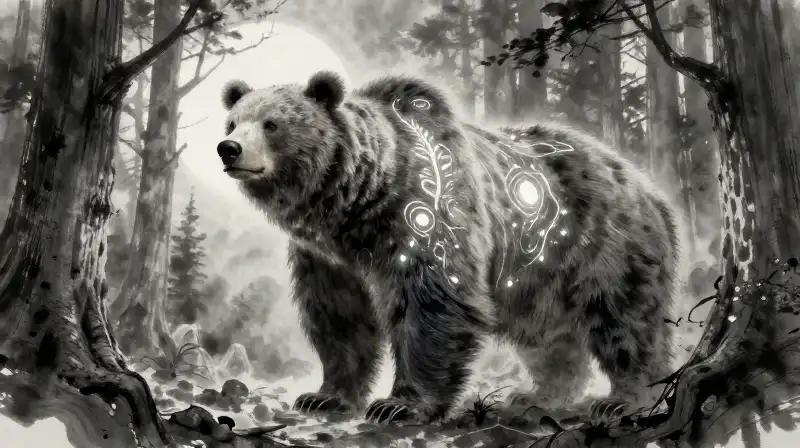
The bear, an ancient and powerful symbol of strength and resilience, takes on particularly mythical and terrifying dimensions across global folklore. When this powerful creature morphs into a monster—be it the raiding demon bear of Japan, the fierce behemoth of North America, or the regal forest king of Finland—it ceases to be merely a beast. It becomes an embodiment of regional anxieties, the unpredictable power of the wilderness, and the deep-seated identity of a community. These large, aggressive figures—like Onikuma and Stiff Leg Bears—function not just as scary tales for children, but as cultural narratives that describe and caution against powerful, sometimes insurmountable, forces inherent in a specific environment 1. The diverse myths surrounding these creature demonstrate a fascinating common thread: the connection between local geography and the creatures that haunt it. A mythical bear may signify a predator from the deep forest, a protector of a village, or even a personal connection to one’s own ancestral land. This article explores three distinct traditions—Japanese, North American, and Finnish—to understand how these powerful animal figures shape and reflect the living heritage of their respective communities.
The Symbol of Power: How Bears Mirror Regional Environments
Across the cultures that feature large, mythological bears, the creatures invariably serve as proxies for the most challenging or formidable aspects of life. They represent forces beyond human control: the unpredictable nature of weather, the dangers of uncultivated land, or the deep, untamable spirit of the wild. Whether these bears are depicted as supernatural demons or as physically monstrous beings, their existence in folklore serves a cautionary and explanatory purpose, helping communities navigate their relationship with a powerful, often unforgiving, environment 1. The myths are deeply localized. The dangers faced by a farming community in a specific region will inspire different kinds of mythical protectors or threats than the dangers faced by an isolated hunter in a northern forest. The bear thus acts as a cultural mirror, reflecting the specific ecological and social fears of its people.
Onikuma: The Demon Bear of Japanese Folklore
In the rich tapestry of Japanese folklore, the concept of the *Oni* (demon) is frequently combined with powerful local animals, resulting in creatures like Onikuma. Onikuma are described as demon bears that are significantly larger than normal bears 1. Unlike bears that merely inhabit the wild, Onikuma are defined by their destructive relationship with human civilization. Their primary notoriety stems from raiding farms and stealing livestock, serving as a potent metaphor for external threats that disrupt the fragile order of human life. The emergence of the Onikuma reflects the historical tension between the settled, agricultural life of human villages and the wild, untamed forces of nature. By attributing these destructive acts to a supernatural, monstrous bear, the tradition both warns against the encroachment of the wild and provides a figure through which the community can symbolically process and confront environmental dangers.
Stiff Leg Bears: Guardians of the North American Wilderness
In Northeast North America, the legends of Stiff Leg Bears offer a rugged, physically visceral take on mythological danger. These bears, sometimes referred to as hairless or naked bears, are described as abnormally large and uniquely characterized by their long, powerful legs 1. Their legend speaks not to supernatural malice, but to the brutal, overwhelming power of the natural world. Their descriptions—with skin resistant to arrows and the capacity to smash through trees—establish them as formidable, purely physical predators that actively hunt people 1. The Stiff Leg Bear embodies the unpredictability and sheer physical danger of the North American wilderness. Their presence in the lore of the region serves as a powerful, albeit mythic, reminder of the raw strength of the land and the necessary caution required to survive within its borders.
Otso: The King of the Finnish Forest
Finnish national mythology offers a completely different, more spiritual perspective on the bear. Otso, the bear, is revered as the King of the forests and the supreme ruler of all bears in old Finnish traditions 1. Unlike the aggressive or threatening bears of other traditions, Otso holds a place of deep cultural integration and personal importance. The traditional depiction of Otso varies; he may appear as a large, ordinary bear, or he might be depicted with antlers, suggesting a connection to a more powerful, spiritual presence 1. Perhaps most significantly, Otso is also a personal name in Finnish heritage. This dual identity—the mythical, powerful forest king and the name worn by people—suggest a profound integration of the animal spirit into the cultural and personal identity of the community 1. Otso thus represents not external danger, but internal, powerful national spirit and ancestral connection to the land.
Navigating Myth: Yokai, Aztec Gods, and Global Bears
A common question that arises when discussing mythical creatures is whether a bear might correspond to a known Yokai (Japanese spirit). While there are many animal-human or animal-element Yokai, the specific concept of a “demon bear” as described in relation to Onikuma falls squarely into the category of regional environmental legends rather than a standard Yokai classification 1. In other, broader areas of folklore, the bear is often given divine status. While the summary does not reference a specific Aztec god of bears, similar archetypes exist worldwide where powerful predators are elevated to a divine or semi-divine status to embody the wild forces that govern nature. These comparisons illustrate the universal human desire to personify the untamed aspects of the world.
The Living Significance of These Traditions
The stories of Onikuma, Stiff Leg Bears, and Otso are not merely relics of a bygone era; they are living cultural artifacts. For the people who hold these beliefs, these myths serve multiple functions: they explain regional ecology, they foster a deep connection to local geography, and they provide a framework for understanding powerful or unpredictable forces. The myths of large, aggressive bear figures like Onikuma and Stiff Leg Bears act as a psychological and cultural defense mechanism, allowing communities to define and caution against powerful environmental dangers 1. Whether the bear is a raiding monster or a regal king, its narrative presence anchors the folklore to the land, transforming a wild ecosystem into a storied, meaningful cultural landscape.
References
Footnotes
Frequently Asked Questions
Is there a bear yokai?
While there are many Yokai involving animals, the specific concept of a demon bear like Onikuma is classified as a regional environmental legend rather than a standard Yokai.
What famous bears are in folklore?
Folklore features several famous bear figures, such as the Japanese demon bear known as Onikuma, the Stiff Leg Bears of North America, and Otso, the king of the Finnish forest. These traditions represent the relationship between local geography and powerful animal figures.
Who is the Aztec god of bears?
The article does not reference a specific Aztec god of bears. It only mentions that similar archetypes exist worldwide where powerful predators are elevated to a divine status to embody the wild forces of nature.
Related Articles