Why the Day of the Dead is a Joyful Festival of Life and Memory

Introduction
The Day of the Dead, or *Día de Muertos*, is far more than a single commemoration; it is a complex, vibrant intersection of Mexican history, spiritual belief, and community love. While some outside observers may perceive the celebration through a lens of solemnity, the lived experience of millions remains one of joyous festivity and profound reconnection. This tradition, recognized by UNESCO as a Representative of the Intangible Cultural Heritage of Humanity (1, 2), serves as a yearly invitation for the living and the recently departed to convene, reminding the community that death is not a termination, but a natural and integrated part of life’s continuous cycle 1. To understand this observance, one must look past the surface decorations and delve into the deep cultural logic that defines this unique relationship with memory and mortality.
The Altar as a Confluence of Realms
At the heart of every observance is the *ofrenda*, or ancestral altar. This structure is the vital center of the entire celebration, functioning as a meticulously crafted bridge where the earthly and spiritual realms meet (1, 2). It is not merely a display; it is a welcoming haven. The *ofrenda* is built as a personalized tribute, adorned with photographs of loved ones, along with the favorite foods and drinks of the deceased, which serve to nourish and honor their return. Guiding the spirits home are elements like candles and incense, creating a sensory pathway (1, 2). The design of the altar is intentionally holistic, often arranged according to the four elements—air, water, fire, and earth—contributing to its profound cultural significance 1. The vibrant colors of the entire celebration, including the intricate use of *papel picado* (perforated paper), reflect the celebratory spirit of the event, even in its most sacred function.
A Path Illuminated by Cempasúchil and Symbols
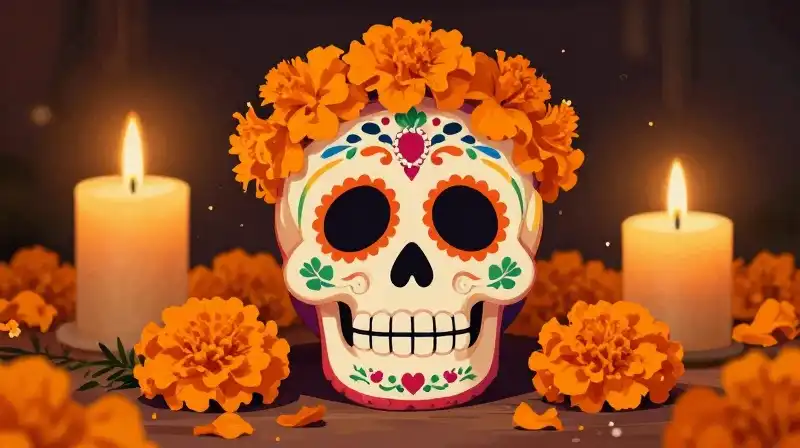
The spiritual guidance of the spirits is strongly tied to nature and color. The marigold, known as *cempasúchil*, is perhaps the most iconic symbol of the Day of the Dead. These orange-gold flowers are used for their brilliant color and strong scent, which celebrants believe possess the ability to light the path for visiting spirits as they return to their homes (1, 2). The arrangement of these flowers transforms the physical landscape into a sacred route of remembrance. In contrast to solemn memorial offerings, the tradition embraces a playful, irreverent view of death. This is most visible in the creative use of *calaveras*, or sugar skulls, and the more generalized skeletal figures, *calacas*. These items function as cheerful reminders, offering a philosophical counterpoint to grief by treating death as a concept to be confronted with humor and beauty (1, 2). Furthermore, the figure of La Catrina—an elegant skeletal figure—originated as a form of political satire by José Guadalupe Posada but has evolved into a widely celebrated icon of this tradition, symbolizing the universal acceptance of death (1, 2).
Beyond the Funerary Rite: The Cycle of Life
The Day of the Dead transcends traditional funerary rites. The celebration actively incorporates the continued life and connection of the community. Beyond honoring those who have passed, the period involves giving gifts to living friends and sharing beloved traditional delicacies, such as *pan de muerto* (bread of the dead). The cultural depth of the event is further evidenced by practices like the writing of *calaveras literarias*—light-hearted, often satirical poems dedicated to the deceased or even the living. These writings showcase the community’s ability to blend reverence with wit. Moreover, cultural traditions, such as staying up all night to receive the deceased or the practice of maintaining pantheons within civil cemeteries, are seen as reflections of social changes that occurred in Mexico during the post-revolutionary period 1.
The Syncretic Debate: Roots and Modern Evolution
The origins of the Day of the Dead are not settled by a single narrative; rather, they are defined by a fascinating cultural negotiation. Cultural discussions among Mexican academics highlight conflicting theories regarding its foundations 1. One perspective suggests genuine pre-Hispanic Aztec roots, while another argues the holiday incorporated elements of European Catholic traditions over time. More recent historical perspectives suggest that the modern, distinctly Mexican form of the holiday may have evolved through deliberate cultural shifts. For instance, some historians argue that the current tradition can be traced to Medieval Europe but asserts that its modern form was an intentional “Cardenist invention” designed to heavily emphasize indigenous iconography over strictly Catholic elements 1. This continuous evolution—a vibrant blending of the ancient, the colonial, and the modern—is key to understanding the enduring life of this tradition today.
Finding Meaning in the Modern Celebration
For contemporary readers interested in the **Day of the Dead sign meaning**, understanding the tradition moves beyond defining its symbols. The celebration is a powerful statement on cultural resilience and the refusal to allow the past to be solely a burden of sorrow. The **Day of the Dead symbols** are not relics; they are active participants in a conversation between generations. Whether exploring the deeper meaning of a *Day of the Dead sign tattoo* or simply understanding the traditions of the holiday, the most important takeaway is the concept of *belong*—the belief that death is a state of transition, and that family and memory are powerful enough to bridge that gap. By engaging with the *ofrenda* and embracing the joy inherent in these rituals, participants affirm that life and death are intertwined, creating a cyclical, perpetual moment of connection that enriches the shared cultural heritage of the community.
References
Footnotes
Related Articles