
Celtic Family Symbols: What the Triquetra and Knots Represent

Introduction
In many traditions, family is represented by a single, definitive icon—a unified crest or a clear, singular image. Yet, the symbols of Celtic heritage regarding family are not singular or fixed. They exist as a nuanced language of interlocking designs and profound mythological resonance. While the Celts deeply valued communal bonds and kinship (1, 2), there is no single, universally agreed-upon Celtic symbol that encapsulates “family” in isolation. Instead, understanding Celtic family symbolism requires looking at a spectrum of knots and motifs, each providing a specific lens through which to view the interconnectedness of lineage, love, and the eternal cycle of life. These symbols are not merely decorative; they are cultural reservoirs that speak to the spiritual connection between individuals, their ancestors, and the world around them.
The Triquetra: The Icon of Eternal Kinship
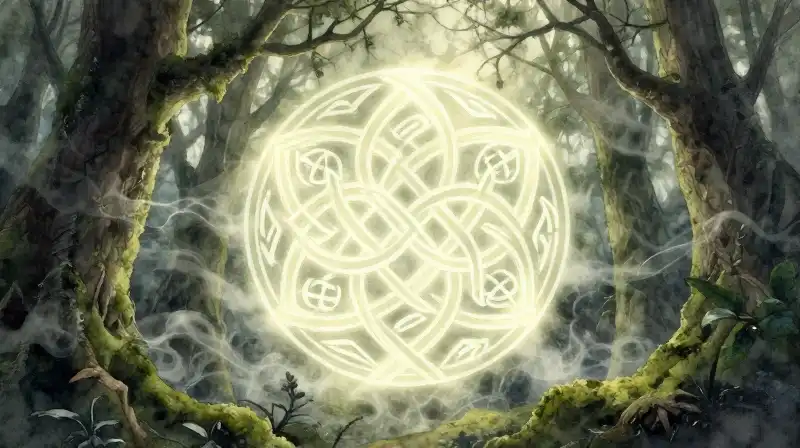
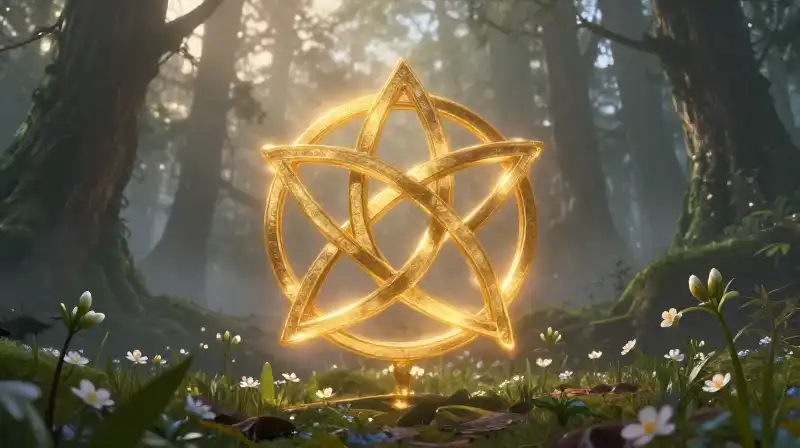
When the topic of family symbolism is raised, the Triquetra—a triple knot—is often the design that comes to the forefront. Historically and widely regarded as an iconic Celtic symbol for family, the Triquetra features three interwoven points that are frequently interpreted to represent the most fundamental stages of human connection: the father, the mother, and the child (1, 2). Its perpetual, flowing design suggests that family ties are not static, but eternal, unbreakable, and endlessly recurring, much like the intertwining nature of the knot itself. This concept of unbroken lineage finds profound roots in early Christian art, most notably in the magnificent illuminated manuscripts like the Book of Kells, where the Triquetra demonstrates its enduring historical presence within the Celtic artistic tradition 1.
Beyond the Triquetra: Different Aspects of the Family Unit
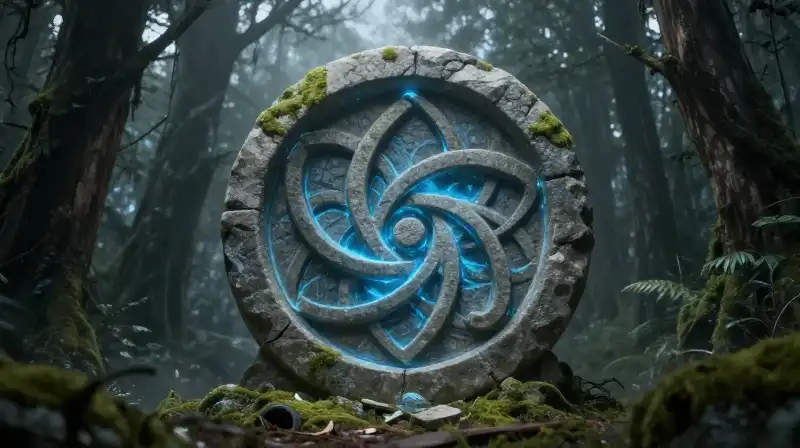
To gain a fuller picture of the tradition, it is helpful to examine other designs that speak to distinct aspects of the family experience. The Triskelion, a spiral composed of three radiating points, offers a different perspective. While it is often seen as symbolizing the eternal cycle of life, death, and rebirth (1, 2), it can also be interpreted as representing an unbroken shared family bond, capturing the powerful momentum of a family unit traversing the past, present, and future 1. Similarly, the Celtic Tree of Life is a foundational element in Celtic spirituality. Here, the sacred tree acts as a bridge between the physical world, the ancestors, and the otherworldly realm. Its symmetrical roots are a powerful metaphor for how family origins provide essential strength and unwavering connection across time (1, 2).
Dara and the Unifying Force of Community
Sometimes, the focus shifts from the individual family unit to the broader communal family—the people. The Dara Knot provides a representation of this collective kinship. Often pictured as a complex knot tied around the sacred oak, the Dara Knot is viewed as representing the dense, complex common roots that bind all Celts together as one vast, unified family unit 1. These motifs demonstrate a broad cultural theme: whether speaking of the parent-child bond or the lineage of a tribe, the enduring pattern is one of intertwining and interdependence.
Modern Expressions and the Language of Love
In the modern context, these ancient spiritual traditions have evolved into forms of contemporary cultural expression. Designers often incorporate traditional knotwork into personal jewelry, such as the Claddagh ring. While the Claddagh is a distinct design, it leverages traditional symbolic language by incorporating the heart for love, the hands for friendship, and the crown for loyalty 1. Another practical application is the use of Ogham, the ancient Irish script sometimes incorporated into modern family jewelry. This application taps into the ancient reverence for nature and tree-based symbols to create deeply personal and meaningful pieces 1.
Specific Meanings: Interpreting Marriage and Partnership
The question of what symbolizes marriage or partnership is particularly interesting, as these symbols are often combinations of the general “family” themes. Serch Bythol, a Welsh motif translating to everlasting love, serves as a motif for an unbreakable family bond. This concept is often visually represented by joining two Triquetra knots together, symbolizing a permanent, intertwined commitment (1, 2). Furthermore, the Triskelion can be utilized in a partnership context to show how two individuals enter into a unified motion, progressing together through life’s cycles.
The Caveat of Provenance: Distinguishing Myth from Tradition
It is important for those studying these traditions to approach them with a critical eye toward provenance. While the symbolic interpretations are rich, there is historical uncertainty regarding the ancient origins of certain designs. Many intricate patterns and designs attributed to the Celtic tradition may be modern creations intended purely for illustrative purposes 1. Therefore, while the modern application of these symbols is powerful and meaningful to contemporary practitioners, we must always be mindful that the symbolism we use today is often a contemporary interpretation of deeper, ancient concepts, rather than a confirmed historical artifact of a specific ancient belief 1.
Understanding the Living Symbol: Context and Application
For those seeking to incorporate these powerful symbols—whether in a family knot tattoo, a necklace, or as a decorative piece—the key is understanding the story behind the form. The symbols live in the hands of those who understand that they are not merely aesthetics. They are vessels of shared history, a visual language of resilience, and a commitment to the unbroken chain of kinship. When interpreting symbols like the Triskelion or the Triquetra, consider whether you wish to emphasize the cyclical nature of life and renewal, or the deep-rooted stability of lineage and love. By understanding the nuanced meanings of the knots, you move past the definition of the symbol and begin to understand the powerful culture it represents.
References
Footnotes
Frequently Asked Questions
What is the Celtic symbol for husband and wife?
Marriage or partnership is often visually represented by joining two Triquetra knots together to symbolize a permanent, intertwined commitment. Furthermore, the Triskelion can be utilized in a partnership context to show how two individuals enter into a unified motion while progressing together through lifes cycles.
Related Articles