Ullr: Origins, Role, and Significance in Norse Mythology

Introduction
In the rich tapestry of Norse traditions, few figures are as defined by what they leave behind, or what they embody in action, as Ullr. He is not a deity who dominates the grand narratives of Ragnarök or governs the deepest mysteries of the cosmos. Instead, Ullr represents the edge—the sharp end of the season, the mastery of the environment, and the enduring power of skill over raw force. To understand Ullr is to look past the polished myths and consider the rugged, material world of early Norse life: the sharp trajectory of the bow, the swift slide of the ski, and the deep roots of local heritage in the Swedish and Norwegian landscapes.
While Ullr’s presence in preserved written texts is surprisingly sparse—leading some modern scholars to view him as an “ancient deity already on the way to oblivion” (1, 2)—his enduring legacy is found etched in runestones, reflected in the names of regions, and maintained in the specialized language of skaldic poetry. He embodies a tradition that exists less in sweeping, formalized epic and more in the specific, powerful skills required to thrive in a harsh, winter-dominated world.
The Visual and Linguistic Traces of Ullr
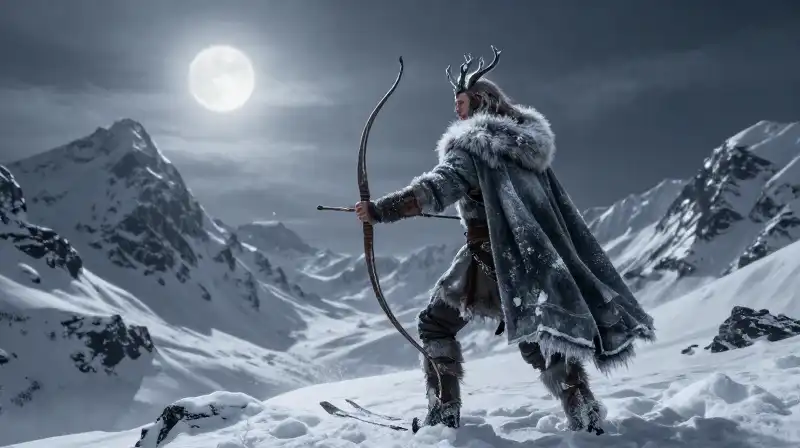
The evidence for Ullr’s importance in the ancient world is often visual rather than purely textual. The most compelling surviving physical representation of the god is an 11th-century Böksta Runestone in Sweden. This depiction shows Ullr holding a bow while skiing, standing alongside the great Odin 3. This imagery serves as a crucial cultural artifact, directly linking the divine with specialized physical activities that were central to life in Scandinavia.
Beyond the stone, Ullr survives through linguistic artistry. In skaldic poetry, his name is often transmuted into powerful kennings, highly stylized metaphors. One such kenning refers to his name as “Ullr’s ship” or a shield (3, 2). Scholars suggest this connection may be rooted in the early designs of sledges or skis, perhaps linking the deity to the very tools of transport and defense (3, 2).
Linguistically, his name is linked to concepts of appearance and prominence. Ullr’s name is traced back to the Proto-Germanic concept of *wulþuz* (meaning ‘glory’) or the Proto-Indo-European *wul-tus* (‘sight, gaze, appearance’). This suggests that, historically, Ullr may have been perceived as a deity associated with great visibility or renown 3. This historical perception of prominence aligns with his later role as a powerful warrior and protector.
The Divine Lineage and Spheres of Influence
The divine lineage provided by Snorri Sturluson in his *Gylfaginning* frames Ullr as a formidable figure, establishing him as the son of Sif and stepson of Thor (3, 2). This relationship establishes him within the established hierarchy of the Norse pantheon, placing him alongside the might of Thor while providing him with a clear ancestral origin. His nature is defined as a capable archer and warrior, though the myths that detail these skills are often more focused on the *how* than the *why*.
While the *Prose Edda* confirms his status as a master archer and ski-runner, the poetic traditions offer very little narrative detail. Instead, the *Poetic Eddas* offer glimpses of his ceremonial context, linking him to specific ritual acts, such as oaths sworn upon his ring (3, 2). His presence is also registered in *Grímnismál*, which lists him as one of twelve specific divine dwellings—his home in Ydalir, or “yew dales” (3, 1, 2). This placement in a specific, listed sacred location suggests that his home was a recognized landmark within the divine geography of the Norse world 3.
Ullr and the Cycle of Winter
A deeper cultural interpretation suggests Ullr’s significance may extend beyond mere hunting and warfare; he may be linked to the very rhythm of the year. Some scholarly interpretations link Ullr to the concept of the seasonal cycle, suggesting he may have personified winter itself. This interpretation posits him as a manifestation of the winter sky, possibly acting as a counterpart or a specific aspect of Odin (1, 2).
This thematic link is further reinforced by the material evidence of his bow. The skill required to use a bow effectively is closely tied to the materials available to the archer. The use of elastic yew as the wood for bows provides a cultural connection between the deity’s identity and the physical material, suggesting a symbiotic relationship between the god and the natural resources of his domain 3.
Furthermore, although the connection remains unsupported by the primary ancient texts, some theories draw parallels between Ullr and other powerful deities like the Greek Apollon or the Vedic Rudr, based on his archer status and winter associations 3. However, such comparisons must be treated as modern scholarly hypotheses, not confirmed ancient beliefs.
Ullr’s Regional Significance and Contemporary Presence
The importance of Ullr in the Norse tradition is demonstrably regional. Toponymic evidence confirms that he held profound religious significance in central Sweden and southern Norway, as evidenced by numerous place names across those areas (3, 1, 2). Yet, this religious footprint is notably absent from the place-naming traditions of Denmark and Iceland. This regional variation highlights how deeply localized the worship and influence of Ullr truly were, tied to the specific landscapes and cultural practices of the Scandinavian north.
When considering how Ullr relates to other gods, like Thor, the link is functional. While Thor embodies immense, thunderous power, Ullr embodies focused, disciplined power. He represents the perfected, highly specialized skill—the archer who relies on precision rather than brute strength. Furthermore, his association with the practical realities of survival (skiing, hunting) contrasts with the more cosmic concerns of gods like Odin, defining his place as a god of masterful capability 3.
Ultimately, Ullr lives on not through lengthy myths, but through his material persistence: in the names of Swedish hills, in the preserved image on an 11th-century stone, and in the enduring cultural memory of survival in the challenging landscape. He is a powerful testament to the traditions of a people who found the divine not just in the grand sweep of destiny, but in the mastery of the elements themselves.
References
Footnotes
Frequently Asked Questions
What did the Vikings call Jesus?
The provided article does not contain any information regarding what the Vikings called Jesus. It focuses entirely on the Norse deity Ullr.
Who is the most feared god in Norse mythology?
The provided article does not specify who the most feared god in Norse mythology is.
How is Ullr related to Thor?
Based on Snorri Sturlusons Gylfaginning, Ullr is established as the stepson of Thor. Beyond this lineage, his relationship to Thor is functional, as Ullr embodies focused, disciplined power and specialized skill in contrast to Thor’s immense, thunderous power.
How important was Ullr to the Vikings?
Ullr was significant because he represented the mastery of the environment and the power of specialized skill over raw force, embodying focused and disciplined power. His importance is evidenced by his imagery on runestones, his use in skaldic poetry, and his regional religious prominence in central Sweden and southern Norway.
Related Articles