How can machine learning classify Cultura historical documents

The world of historical documents—ancient scrolls, medieval manuscripts, colonial correspondence, and more—represents a vast and often fragmented record of human civilization. Traditionally, the analysis of these documents has been a painstaking, labor-intensive process, relying heavily on expert historians and paleographers. This process is slow, expensive, and prone to subjective interpretation, limiting the scope of research and hindering wider access to these invaluable resources. The sheer volume of material, often dispersed across numerous institutions globally, makes comprehensive study even more challenging.
Fortunately, the burgeoning field of machine learning (ML) offers exciting possibilities for revolutionizing the way we understand and utilize Cultura historical documents. By leveraging the power of algorithms to analyze textual and visual features, ML can automate tasks like classification, transcription, and translation, significantly accelerating research and potentially unlocking new insights. This isn't about replacing human scholars, but rather providing them with powerful new tools to enhance their capabilities and expand the scope of their inquiries.
## Document Image Preprocessing & Feature Extraction
The first crucial step in applying ML to Cultura historical documents involves preparing the images themselves. Raw scans or photographs often suffer from degradation, noise, and uneven lighting, making them unsuitable for direct analysis. Effective preprocessing techniques, such as noise reduction filters, contrast enhancement, and deskewing, are vital to improve image quality and ensure accurate feature extraction. These processes aim to restore the original content as closely as possible while minimizing the introduction of artificial artifacts.
Feature extraction then converts the processed images into numerical representations that ML algorithms can understand. Traditional methods might include analyzing edge density, texture patterns, and color histograms. However, more modern approaches utilize Convolutional Neural Networks (CNNs) that automatically learn relevant features directly from the image data, capturing subtle variations in handwriting styles, ink types, and paper textures that might be missed by manual methods. The quality of the extracted features is paramount for the subsequent classification accuracy.
Finally, it’s crucial to consider the diversity of document formats. From handwritten manuscripts to printed books and administrative records, each type demands specific preprocessing and customization of feature extraction pipelines. Generic approaches often fail to capture the nuances of different document types, necessitating tailored strategies to ensure optimal performance.
## Textual Analysis and Natural Language Processing (NLP)
Once the text within the document is discernible (often via Optical Character Recognition - OCR, which itself is increasingly powered by ML), Natural Language Processing (NLP) techniques come into play. Tokenization, the process of breaking down text into individual words or units, is a foundational step. This is followed by tasks like stemming or lemmatization, which reduce words to their root forms to account for variations in tense and inflection.
More sophisticated NLP methods, such as Named Entity Recognition (NER), can identify and classify specific elements within the text, like names of people, places, and organizations. This can be incredibly valuable for automatically identifying key entities and building knowledge graphs to represent relationships between them. Sentiment analysis can even be employed to gauge the emotional tone of the document, providing insights into the author's perspective and the historical context.
However, working with historical text presents unique challenges. Archaic language, spelling variations, and scribal errors can significantly degrade the performance of standard NLP models. Specialized training datasets and adaptation of existing models are often required to overcome these issues and achieve acceptable accuracy. The language of the document is obviously key to choosing the most effective NLP tool.
## Classification Models: Supervised and Unsupervised Learning
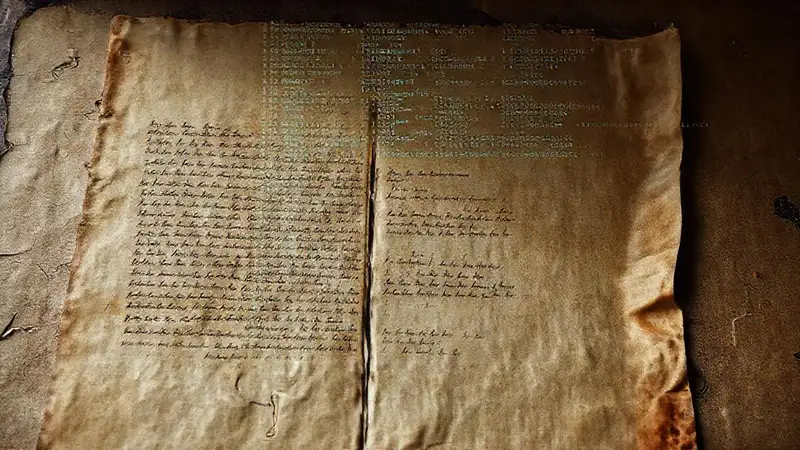
The core of the ML classification process involves training models to categorize documents based on their features. Supervised learning approaches, such as Support Vector Machines (SVMs) or Random Forests, require labeled datasets where documents are already assigned to specific categories (e.g., "legal document," "personal letter," "religious text"). These models learn to associate specific features with each category, enabling them to predict the category of new, unseen documents.
Unsupervised learning techniques, like clustering algorithms (e.g., k-means), offer an alternative when labeled data is scarce. These methods group documents based on their inherent similarities without prior knowledge of the categories. While requiring more interpretation, unsupervised learning can reveal patterns and structures within the data that might not be apparent through traditional methods, potentially leading to the discovery of new categories or subcategories.
The choice between supervised and unsupervised learning depends on the availability of labeled data and the research goals. Often, a hybrid approach combining both methods can prove beneficial, leveraging labeled data to refine the results of unsupervised exploration. Furthermore, active learning, where the model strategically requests human labels for the most uncertain documents, can significantly improve performance with minimal labeling effort.
## Addressing Challenges: Data Scarcity, Bias, and Explainability
Applying ML to Cultura historical documents isn't without its hurdles. A significant challenge is the often limited availability of annotated data, particularly for less common document types or languages. Overcoming this scarcity can involve techniques like data augmentation (creating artificial examples from existing data), transfer learning (leveraging knowledge from models trained on related tasks), and few-shot learning (training models with very limited data).
Bias in the training data can also lead to skewed classifications. For example, if the dataset predominantly contains documents from a specific social class or geographic region, the model may inaccurately classify documents from other groups. Careful data curation and bias mitigation strategies are essential to ensure fairness and avoid perpetuating historical inequalities.
Finally, the "black box" nature of some ML models (especially deep learning models) raises concerns about explainability. It's often difficult to understand why a model makes a particular classification. Developing methods to interpret model decisions – such as feature importance analysis and counterfactual explanations – is crucial for building trust and allowing historians to validate the results and integrate them into their research.
## Conclusion
The application of machine learning to Cultura historical documents holds tremendous promise for transforming historical research. From automating tedious tasks like document classification to uncovering hidden patterns and relationships within historical data, ML tools offer unprecedented opportunities for discovery. However, responsible and ethical implementation is paramount.
Addressing challenges related to data scarcity, bias, and explainability is crucial to ensure that ML models are accurate, fair, and transparent. By fostering collaboration between historians, computer scientists, and data scientists, we can unlock the full potential of ML to deepen our understanding of the past and make these invaluable cultural artifacts more accessible to a wider audience. The future of historical scholarship will undoubtedly be shaped by this convergence of human expertise and artificial intelligence.
Deja una respuesta